

22 Feb Under Fire: Three Rare WWII Hadassah Zionist Posters 1945 WW2
Three Posters, One Defining Era – Hadassah, World War II, and the Struggle for the Future of the Jewish Yishuv in Palestine
These three exceptionally rare posters, produced by Hadassah during World War II, are far more than fundraising graphics. They are visual testimony to a dramatic historical reality in which the Jewish community in Mandatory Palestine struggled for survival, built vital civil institutions, and faced military and political threats simultaneously.
Between 1939 and 1945, Palestine was under British Mandate rule, and the 1939 White Paper fundamentally altered the fate of Jews seeking refuge there. It limited Jewish immigration to 75,000 over five years, after which further immigration required Arab consent. In practice, this meant the gradual closing of the gates at the very moment European Jewry was descending into the darkest phase of Nazi persecution and genocide.
Immigration ceased to be an administrative process and became a political and operational struggle. The Yishuv organized “Aliyah Bet” (illegal immigration), sending ships from European ports in desperate attempts to bypass British quotas. Many vessels were intercepted at sea; passengers were detained in camps such as Atlit and later deported to Cyprus. Each arrival involved diplomatic tension, confrontation with Mandate authorities, and often real danger. The restrictions were not abstract policy—they directly affected the lives of refugees trying to survive.
At the same time, the regional military situation was unstable and threatening. When Fascist Italy joined the war alongside Germany, the Middle East became a strategic theater. In 1940–1941, Italian aircraft bombed civilian targets in Tel Aviv and Haifa. Haifa, with its refineries and strategic port, was a primary target. The bombings caused civilian casualties and tangible destruction, making it clear that the war was not distant—it was present.
Meanwhile, the North African campaign intensified. The advance of Axis forces under Rommel created genuine concern that Egypt might fall and that Palestine itself could face invasion. Emergency defense plans were prepared within the Yishuv. Civil defense systems were organized, blackout drills were conducted, trenches were dug, and the population was instructed on how to respond to air raids. A constant sense of alert defined daily life.
Shortages were severe. The import of medicines and medical equipment was restricted due to wartime conditions and naval blockades. Food, fuel, and essential supplies were rationed. Hospitals and clinics operated under difficult constraints, carefully managing limited resources. The healthcare system had to remain functional both for ordinary civilian needs and in preparation for possible mass casualties from bombings or regional escalation.
Within this reality, Hadassah operated as a pillar of stability. Founded in 1912 in New York by Henrietta Szold, Hadassah was established as a Zionist women’s organization dedicated to strengthening Jewish life in Palestine through medicine and social infrastructure. Over the decades it built nursing stations, hospitals, maternal and child welfare clinics, vaccination programs, and public health initiatives. The Hadassah Medical Center on Mount Scopus became a symbol of Jewish modernity and scientific advancement in the region.
During the war years, emergency services expanded. Ambulance units, first aid networks, and public health programs operated under pressure. Holocaust survivors who managed to reach Palestine—often after perilous journeys—arrived in need of medical treatment and rehabilitation. Hadassah’s institutions provided an existing and functioning framework capable of absorbing vulnerable populations despite shortages and instability.
Each of the three posters reflects a different dimension of this historical moment.
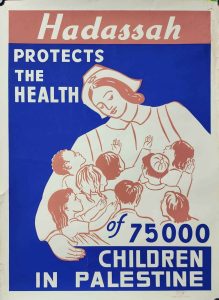
The first emphasizes the protection of 75,000 children—an explicit statement that the nation’s future depended on the health of its youngest generation.
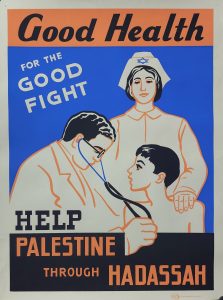
The second links “Good Health” to “the Good Fight,” presenting healthcare as part of the broader moral and national struggle.
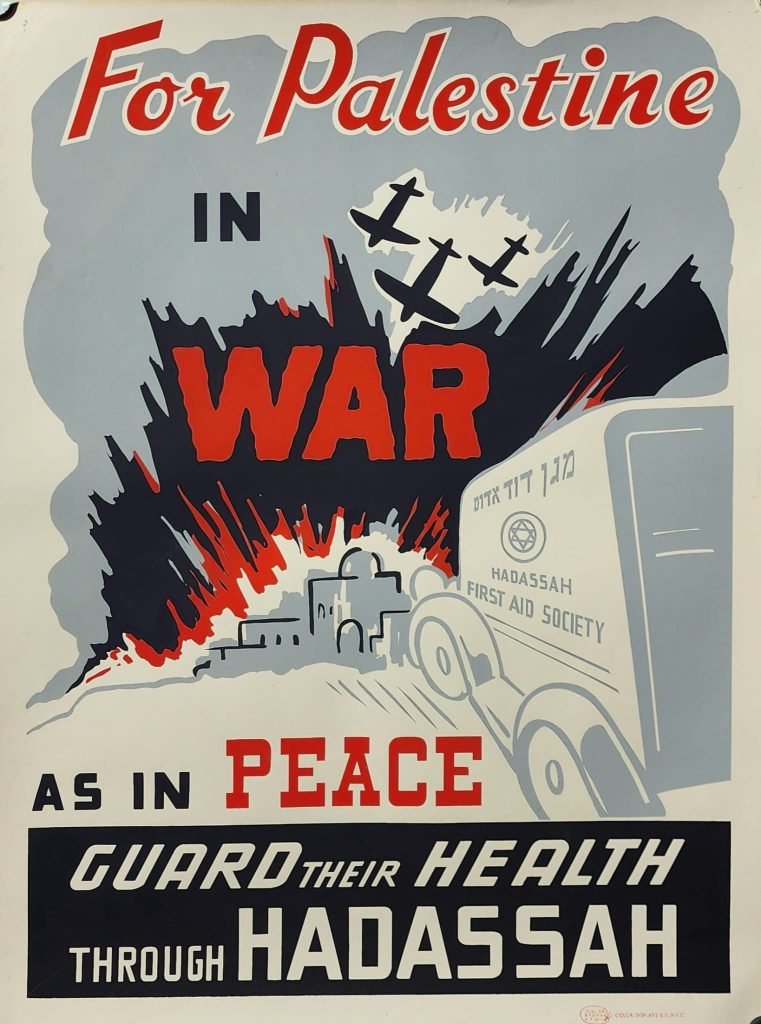
The third depicts war directly—bombing aircraft, explosions, and a Hadassah First Aid Society ambulance moving forward “in war as in peace.”
Together, they construct a clear narrative: medicine was not peripheral to the national effort—it was central to it.
American Jewish solidarity was decisive. Donations funded equipment, salaries, ambulances, wards, and preventive programs. Supporting Hadassah was not symbolic charity; it was direct participation in sustaining Jewish life and preparing the foundations of a future state.
The comparison to the present is unavoidable. Today, as Israel faces ongoing military challenges, healthcare systems and civilian resilience remain central to national survival. Once again, global Jewish solidarity—through emergency fundraising, hospital support, and communal mobilization—reinforces Israel’s ability to endure.
Then, as now, survival was not determined solely on the battlefield. It depended equally on doctors, nurses, ambulances, organized philanthropy, and a shared sense of responsibility across the Jewish world.
These three rare posters stand as tangible historical witnesses to a time when building hospitals and protecting children were acts of national defense—and when global Jewish partnership was essential to survival.
-
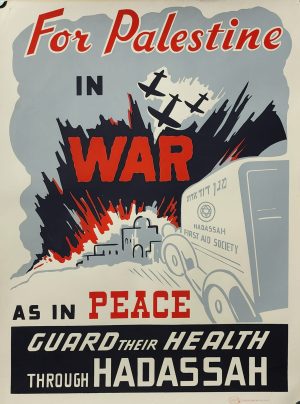
Extremely Rare Vintage Jewish Zionist 1945 Poster – For Palestine “Ertez Israel” in War as in Peace, Guard Their Health Through Hadassah (WWII Era)
$3,200.00 Buy Now -
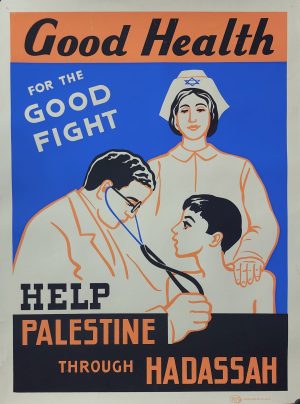
Extremely Rare Vintage Jewish Zionist 1945 Poster – Good Health for the Good Fight, Help Palestine “Eretz Israel” Through Hadassah (WWII Era)
$3,200.00 Buy Now -
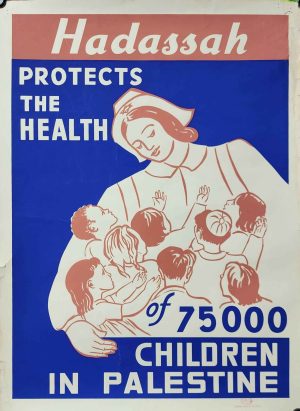
Vintage Jewish Zionist 1945 Poster – Hadassah Protects the Health of 75,000 Children in Palestine “Ertz Israel” (WWII Era Fundraising Print) Extremely Rare
$3,200.00 Buy Now
Sorry, the comment form is closed at this time.