

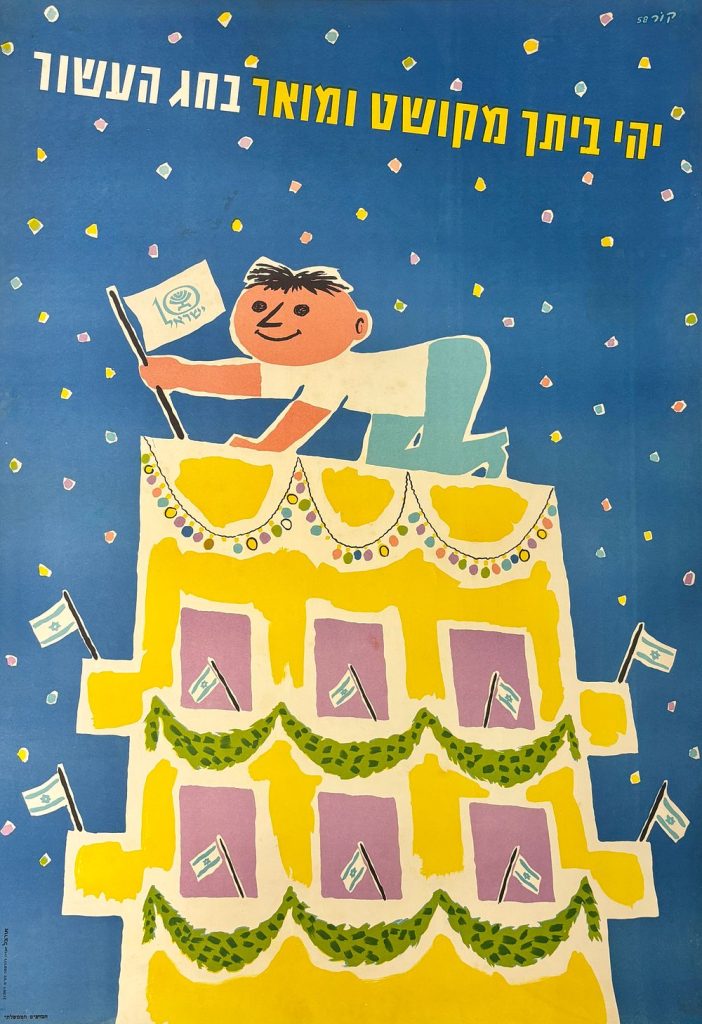
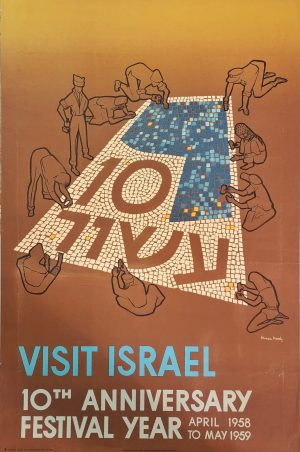
21 Dec Celebrating Ten Years of Independence: Israel’s 1958 Tenth Anniversary and the Birth of a Nation
Ten Years of a Dream Fulfilled
Israel at Ten (1958): A Defining Moment in the Life of a Young Nation
In 1958, the State of Israel marked ten years since its founding—an extraordinarily short span in historical terms, yet one compressed with events that, in other nations, unfold over generations. The War of Independence, mass immigration, the establishment of new towns and settlements, the building of government institutions, a standing army, and a developing economy—all combined to create a constant sense of urgency.
The Tenth Anniversary celebrations were the first moment in which a young state could pause, look back, and declare with confidence: we did not merely survive—we built.
A Decade Dense with History
Israel’s first decade was not a time of routine, but of continuous national effort. Society lived between the fresh memory of war and the daily struggle for economic and social stability. The anniversary celebrations marked a profound shift in consciousness—from survival to cautious self-confidence, from a nation fighting for its existence to one seeking to define its identity and future.
Who Decided—and How the Celebration Was Shaped
Preparations for the anniversary began well in advance and were conducted at the highest state level. Government committees were established, bringing together ministries, the Israel Defense Forces, the Jewish Agency, the Histadrut, and cultural institutions. In the spirit of the era, planning was centralized and deliberate: the state would tell its own story.
Under the leadership of David Ben-Gurion, clear guiding principles were set—statehood, the integration of civilian and military achievement, and a nationwide scope.
Three core principles guided the decisions:
-
Statehood and Sovereignty – emphasizing order, organization, and governing capability.
-
Strength and Construction Side by Side – the IDF as a guarantee of survival, alongside agriculture, industry, and culture as proof of a thriving civilian life.
-
Inclusive National Belonging – a celebration not only of the center, but of the entire country.
Where the Events Took Place
The celebrations extended across the entire country, with each region playing a symbolic role.
Tel Aviv served as the central stage. A large-scale IDF parade showcased military units, vehicles, tanks, and aircraft. Beyond spectacle, the parade conveyed a clear message of security and independence at a time when existential threats still loomed. Major performances, exhibitions, and public displays filled the city, whose streets were adorned with flags and festive lighting.
Jerusalem carried a different tone—more ceremonial and symbolic. Events there emphasized historical continuity, sovereignty, and the deep connection to the Jewish past. Choosing Jerusalem as a focal point conveyed a careful yet unmistakable national statement, particularly given the city’s sensitive international status at the time.
Haifa and the port cities highlighted Israel’s practical, economic dimension: industry, trade, ports, and immigration. Exhibits of factories, ships, and infrastructure demonstrated that Israel was not merely an ideological vision, but a functioning economy connected to the wider world.
At the same time, kibbutzim, development towns, and new settlements held hundreds of local events—parades, communal sing-alongs, theatrical performances, and ceremonies. It was essential that residents of transit camps, border communities, and peripheral towns felt fully included in the decade and its celebration.

Types of Events—and the Messages They Carried
Each type of event was carefully chosen, carrying a clear and intentional message:
-
Military parades and displays – expressions of strength, discipline, and the ability to defend oneself.
-
Agricultural and industrial exhibitions – showcasing achievements in irrigation, desert farming, industry, and infrastructure, symbolizing the “conquest of the wilderness” and faith in progress.
-
Culture, dance, and song – folk dance troupes, choirs, and Hebrew theater as tools for shaping a shared national identity within a diverse immigrant society.
-
Education and community – schools and youth movements played an active role, reflecting the belief that the younger generation embodied the promise of Israel’s future.
The Street and the Collective Memory
Public space itself became a stage. Streets, squares, and neighborhoods filled with people—new immigrants alongside veterans, soldiers beside children. For a brief moment, a shared narrative emerged: we are all part of one great story, even if our daily lives were vastly different.
The Tenth Anniversary celebrations helped forge a collective memory for an entire generation—one that saw itself as an active participant in the fulfillment of a historic dream.
Looking Back
With the benefit of hindsight, the celebrations appear carefully orchestrated, unified in message and tone. They emphasized achievement, belief, and capability, while downplaying tensions, hardships, and divisions that would later come to the fore. In this sense, they also reflect a measure of innocence and a deep faith in the power of national endeavor.
Conclusion
The Tenth Anniversary celebrations of the State of Israel were far more than a national holiday. They were a rite of passage—from idea to state, from struggle to construction, from fear to identity.
Only ten years after its founding, Israel presented to its citizens and to the world the image of a young, sovereign, and confident nation—one convinced that its journey had only just begun.
Sorry, the comment form is closed at this time.