

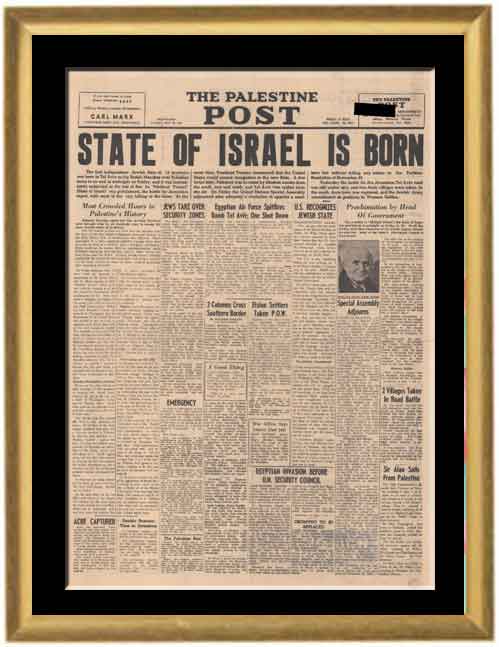
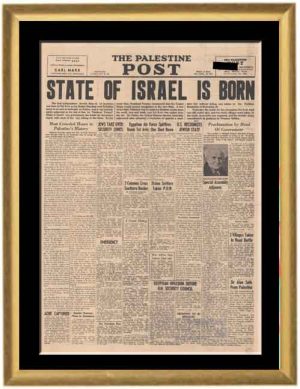
11 Jan “When History Became a Headline: The State of Israel Is Born” The Palestine Post 1948
One Page. One Headline. One Nation.
The Palestine Post, May 1948 – When History Became a Headline
There are historical objects you can read about—and then there are those you can hold in your hands and feel.
The May 1948 issue of The Palestine Post belongs firmly to the latter. It is not merely an old newspaper, but a document born out of danger, uncertainty, and courage—preserved to this day as a symbol.
For collectors, museums, and scholars, it is one of the most iconic artifacts associated with the founding of the State of Israel. And for anyone who holds it, it is to hold a single day on which history changed course.
On a tense night in May 1948, when no one yet knew whether morning would bring a sovereign state or total disaster, an extraordinary newspaper was printed in Jerusalem. Not a regular edition, not a celebratory issue—but a single sheet of paper, an emergency Special Edition, rushed to press under wartime conditions, acute paper shortages, and the very real threat of violence. Across the top ran one stark, astonishing headline:
THE STATE OF ISRAEL IS BORN.
To grasp the power of that moment, one must first understand the newspaper itself. The Palestine Post was founded in Jerusalem in 1932 by Zionist journalist Gershon Agron. It was deliberately published in English. This was not a paper speaking inward to the local Jewish population, but outward—to British Mandate officials, diplomats, foreign correspondents, and Jewish leadership abroad. It was the voice of the Jewish community addressing the world: measured, factual, and impossible to dismiss as mere sentiment or propaganda.
Throughout the years of the British Mandate, the paper operated under heavy censorship and political pressure, and at times under direct physical threat. In February 1948, the newspaper’s offices in Jerusalem were bombed in a deadly attack that killed staff members and destroyed much of the press. The message was unmistakable: this was not just a newspaper—it was a political symbol. And yet, despite the devastation, the paper continued to publish. Its very survival was an act of defiance.
Then came the decisive day. On May 14, 1948, at 4:00 p.m., in the modest hall of the old Tel Aviv Museum on Rothschild Boulevard, David Ben-Gurion stood before a small audience and read aloud the Declaration of Independence. Ben-Gurion was not only a political leader but a man acutely aware of history. He understood that he was writing a chapter that would be read for generations—while fully aware that it was a perilous gamble. The British had withdrawn, Arab armies were preparing to invade, and the Jewish community stood on the brink of the War of Independence.
State of Israel is born
Headline
PALESTINE POST
Sorry, the comment form is closed at this time.