

08 Feb El Estado Judío: A Rare Poster That Captured the Moment Before Israel’s Birth 1947
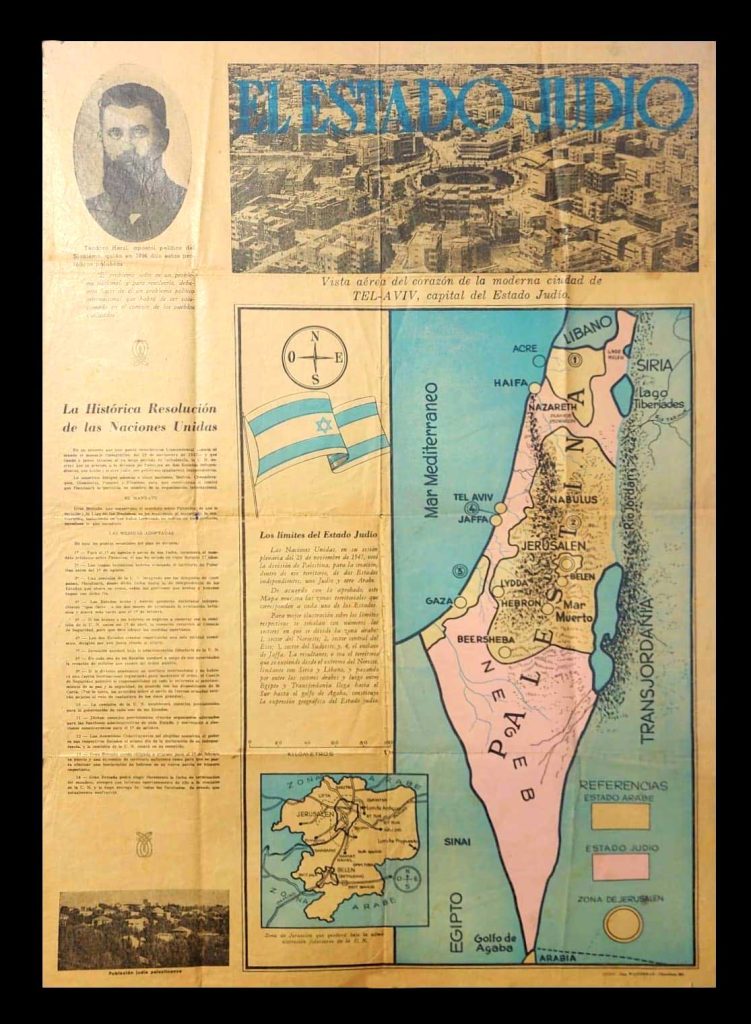
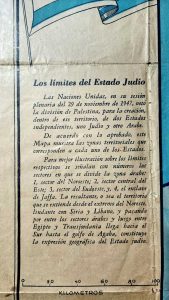
The poster “El Estado Judío” is a rare visual document that captures a singular historical moment: the days and weeks immediately following the United Nations decision of November 29, 1947 (Resolution 181), which called for the partition of Eretz Israel into two states—one Jewish and one Arab—and for Jerusalem to be placed under an international regime. This decision was not merely a formal diplomatic act, but a profound turning point in Jewish and Zionist consciousness worldwide. The poster before us is a direct and immediate visual response to that historic vote.
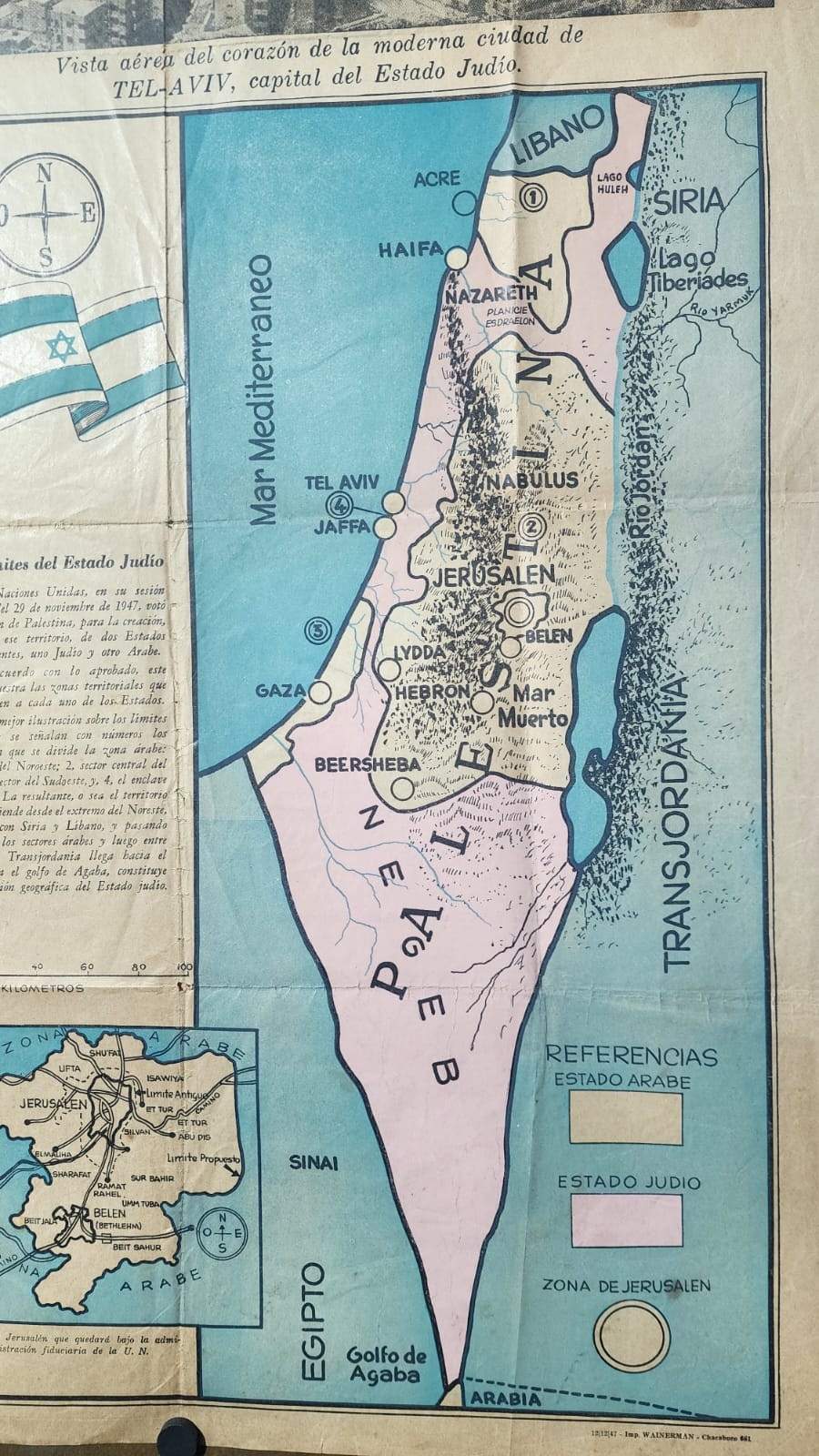
At the visual center of the poster appears the partition map: a clear, political, and carefully rendered map showing the territories allocated to the proposed Jewish state alongside those designated for the Arab state. A separate enlarged inset focuses on the Jerusalem area, which was intended to function as an international zone under United Nations supervision. This cartographic emphasis reflects both the city’s centrality to the international debate and the political complexity already evident at that early stage. The map is not only a geographic tool, but a political and educational statement, designed to explain, persuade, and document.
The upper portion of the poster incorporates symbolic photographic imagery of great significance: a portrait of Theodor Herzl, the founder of modern political Zionism, alongside a photograph of Dizengoff Square in Tel Aviv, a symbol of the modern Hebrew city and the tangible realization of the Zionist vision. The juxtaposition of Herzl with Tel Aviv creates a clear ideological continuum—from political vision to lived reality, from idea to the emerging state.
The accompanying text, printed entirely in Spanish, explains the United Nations decision and its historical implications. The choice of language is not incidental; it points directly to the intended audience and historical context: Jewish and Zionist communities in South America—particularly in Chile, Argentina, Uruguay, Brazil, and neighboring countries—who were deeply engaged in supporting the creation of a Jewish state. Printed in Chile in December 1947, almost in real time, the poster attests to the speed of response, emotional involvement, organizational capacity, and the urgent need to disseminate clear and authoritative information to both Jewish and non-Jewish audiences.
South American Jewish communities played a significant, and often under-acknowledged, role in the process leading to the establishment of the State of Israel. They were actively involved in fundraising, political advocacy, Zionist education, and the distribution of informational materials, strengthening the bond between the Jewish Diaspora and the Jewish community in Palestine. Posters such as this served as key instruments of Zionist public diplomacy: displayed in Jewish community centers, assembly halls, educational institutions, and at times in the broader public sphere, they visually articulated the international legitimacy of the Jewish state.
Beyond its historical significance, the poster also reflects the visual culture and printing practices of its time. The combination of photography, cartography, and political text within a single graphic work exemplifies the educational and persuasive strategies employed by Zionist organizations in the mid-20th century. Its production and circulation in South America underscore the fact that the story of Israel’s establishment was not a purely local event, but a global process in which Jewish communities across continents played an active and conscious role.
Today, “El Estado Judío” is regarded as a rare and important collectible artifact: a visual record of the critical moment between the United Nations decision and the declaration of the State of Israel. It embodies the convergence of vision, politics, community engagement, and historical memory. More than a document of what was decided in the halls of the United Nations in New York, it reveals how that decision was received, understood, and embraced thousands of kilometers away—within the Jewish communities of South America—and how those communities, in their own way, contributed to the birth of the State of Israel.
Sorry, the comment form is closed at this time.