

06 Apr “Wake up Israel! – They will soil your flag” – The Oslo Accords and Public Opposition to the Agreements
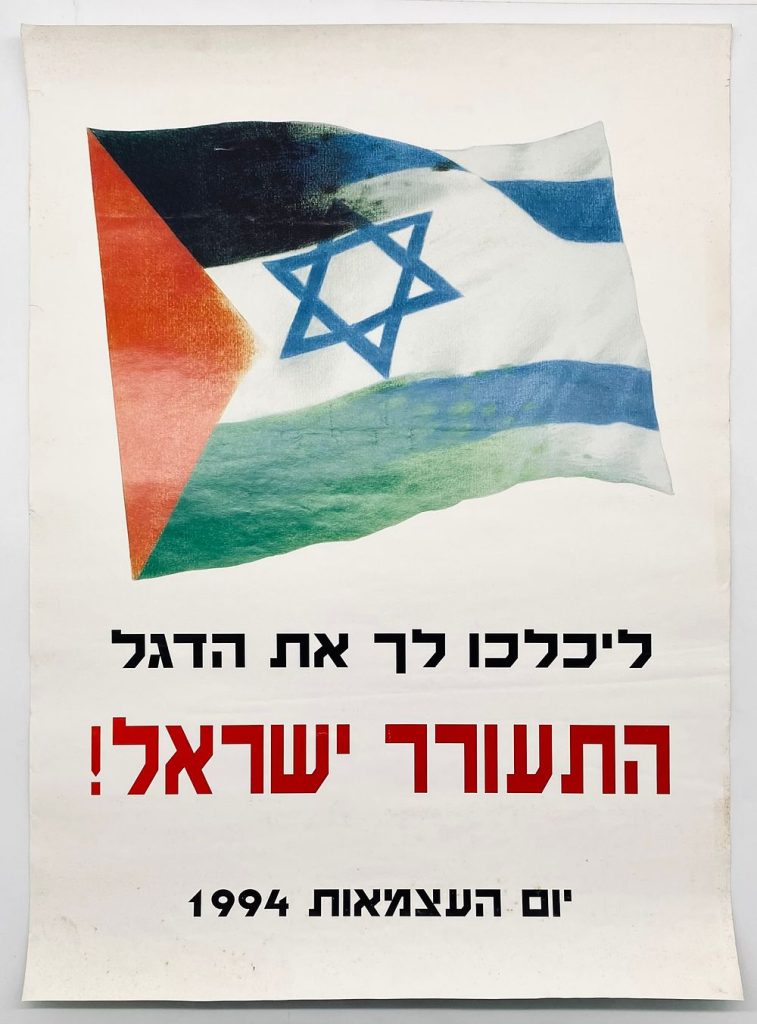
The prominent slogan in the poster – “They will soil your flag – Wake up Israel!” – is not merely a phrase, but a sharp call to awakening born out of the opposition to the Oslo Accords. It reflects the sense of urgency and warning felt by an entire segment of Israeli society, which viewed the political process as a real danger to the future of the state and acted decisively to stop it.
The Oslo Accords, signed in 1993 between the State of Israel and the Palestine Liberation Organization under the leadership of Yasser Arafat, were a series of political agreements intended to bring an end to the Israeli–Palestinian conflict through mutual recognition and the transfer of governing authority to the Palestinians in parts of Judea, Samaria, and Gaza. The agreements were signed during the government of Yitzhak Rabin, with key involvement from Shimon Peres, and were presented as a historic step toward peace.
The right-wing public in Israel strongly opposed the agreements and launched a broad public struggle that included demonstrations, campaigns, and political propaganda. This poster is part of that effort, reflecting the deep concern and fear within that camp regarding the future—particularly the strengthening of terrorist organizations as a result of the political process.
“Wake up Israel! – They will soil your flag” Independence Day 1994
This powerful poster, printed in 1994 by a concerned right-wing movement in the State of Israel, captures a dramatic and highly charged moment in the country’s history—the Oslo era. As the political process advanced in the mid-1990s, strong opposition emerged within Israeli society, especially from the right, which viewed the process as a serious threat to the future of the state.
Opposition to the Oslo Accords was not limited to political statements; it evolved into a wide and dynamic public movement. Mass demonstrations, protest rallies, and public gatherings were held across the country, where warnings about the consequences of the agreements were voiced. Activists established field headquarters, distributed posters, stickers, and flyers, and created campaigns aimed at influencing public opinion. Organizations such as the Yesha Council played a central role in organizing resistance, alongside grassroots activists, ideological movements, and public figures.
Leading right-wing figures, including Benjamin Netanyahu (then head of the opposition) and Ariel Sharon, participated in rallies, addressed large audiences, and led a sharp critical line against the agreements. The activity also included parliamentary opposition, attempts to influence legislation, and an intensive media effort designed to challenge the political direction led by the government.
The poster, with its striking image of the Israeli flag merging with the colors of the Palestinian flag, directly expresses the sense of threat felt by many at the time. For opponents of the agreements, this was not a promising diplomatic process, but a dangerous concession involving the relinquishing of strategic assets, the introduction of hostile elements into the heart of the territory, and the undermining of national security foundations.
Within this camp, a clear perception developed that the Oslo Accords not only failed to bring peace, but instead created a new security reality in which terrorist groups strengthened, gained territorial footholds, and became a more significant threat to Israeli civilians. According to this view, the political process granted these actors operational space, resources, and legitimacy—a development that intensified over the years.
From this perspective, these developments are not confined to the past but continue to resonate in the decades that followed—where severe events, including the October 7 attacks, are seen by many as consequences of that controversial policy.
Today, this poster is more than a graphic item—it is a historical document. A living testimony to a period of deep ideological struggle, mass protests, social division, and a debate that, in many ways, has never truly ended.
Sorry, the comment form is closed at this time.