

02 Aug “The Soldier of Art”: The 1942 Collier’s Cover That Prepared America to Fight Evil”
The Highwaymen of the 20th Century and the Threat from the Skies: A Look into Collier’s, Winter 1942
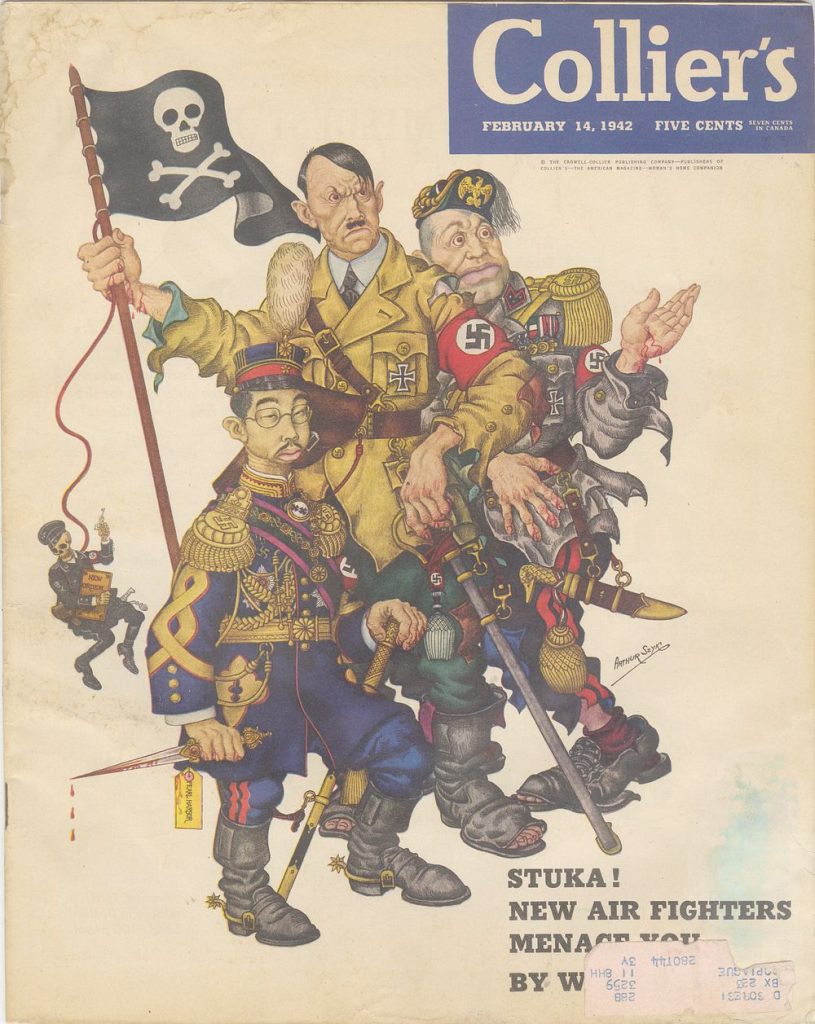
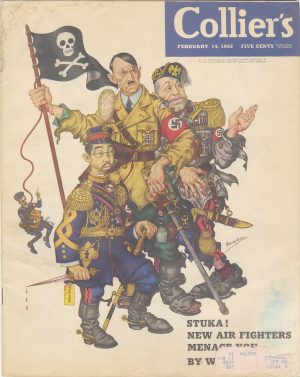
Cover illustrated by Arthur Szyk
In these days, as the war against Iran and its proxies demonstrates once again the tangible threat posed by extremist regimes seeking to undermine stability and order, history takes on a profound and ever-more relevant meaning. The sense of a free society compelled to suddenly awaken against an “axis” of hostile forces, and the need to mobilize the home front, the media, and the civil fighting spirit, send a chilling echo of what occurred across the ocean over eight decades ago.
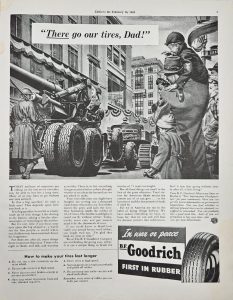
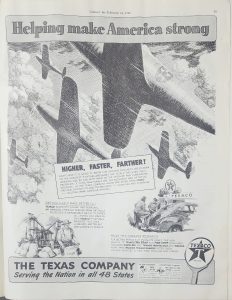
On February 14, 1942, the United States was a nation in trauma but rapidly awakening. Just two months prior, the surprise attack on Pearl Harbor shattered the American illusion of isolationism in an instant, dragging the country deep into the cauldron of World War II. The American public found itself transitioning overnight from a peacetime economy to an economy of total war. Anxiety over the bombing of American coastal cities became palpable, and citizens were called upon to make daily sacrifices, ranging from the mass drafting of young men to the front lines to the strict rationing of basic goods, fuel, and rubber (as is well-reflected in the advertisement for B.F. Goodrich tires in the magazine’s inner pages, urging citizens to preserve their tires for the war effort). In this tense atmosphere, a new issue of “Collier’s” magazine was published, serving not only as a source of information but as a tool for shaping national consciousness and boosting morale.
Founded in 1888, “Collier’s” was one of the most popular and influential magazines in the United States at the time. It was known for its innovative approach to investigative journalism and earned a reputation as a standard-bearer for social reform. In the 1940s, its circulation reached millions, and it served as a platform for in-depth articles, short stories by renowned authors, and illustrations by the leading artists of the era. During World War II, “Collier’s” was a primary source of information for the American public, providing reports from the frontlines alongside content designed to strengthen the home front and shape public opinion, often featuring renowned journalists like Ernest Hemingway and Martha Gellhorn.
Eleanor Roosevelt called Arthur Szyk a “soldier in art” and a “one-man army” due to his immense contribution to the fight against fascism through his artwork.
At the forefront of this propaganda battle stood the artist who created the issue’s cover: Arthur Szyk. Szyk was a Jewish-Polish artist and caricaturist who was exiled from his country at the outbreak of the war and found refuge in the United States. He brought with him an exceptionally unique style, drawing inspiration from ancient illuminated manuscripts and miniature prints, yet utilizing it to produce sharp and piercing political caricatures. Szyk viewed his art as a veritable weapon in the war against fascism, and his works were so influential that Eleanor Roosevelt referred to him as the “soldier of art of the free world.”
On the cover of this issue, Szyk uses his talent to strip the Axis leaders of the majesty and grandeur they tried to project, presenting them as they truly are: a gang of highwaymen, pirates, and murderers. Adolf Hitler stands in the center as the arch-villain, scowling, wearing a swastika and an Iron Cross, while his hand brandishes a black pirate flag with a skull and crossbones instead of the flag of the Reich. To his left stands the Japanese Emperor Hirohito, in a lavish yet ridiculous military uniform, clutching a traditional katana sword and a blood-dripping dagger proudly bearing the chilling label “Pearl Harbor”. Squeezed on the right is Benito Mussolini, the leader of Fascist Italy, depicted in a particularly pathetic light—bruised, torn, degraded, and wearing a swastika armband that indicates his submission and status merely as Hitler’s henchman. The image is completed by a tiny skeleton in a Nazi uniform hovering in the background, tied by a string to Hitler’s hand, holding a document reading “New Order”—a clear implication that the Axis’s new world order brings with it only death and starvation.
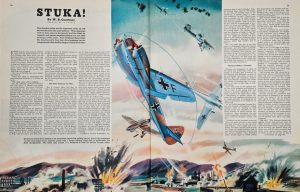
Alongside Szyk’s psychological warfare, the magazine also highlights the tangible military and technological threat facing America and its allies. The sensational cover headline, “STUKA! NEW AIR FIGHTERS MENACE YOU”, directs readers to an extensive investigative article about one of the most terrifying weapons of the German war machine. The Junkers Ju 87, commonly known as the “Stuka”, was a formidable dive bomber that served as the spearhead of the “Blitzkrieg” (lightning war). The aircraft was known not only for its deadly precision in steep dive-bombing but primarily for the psychological terror it sowed: special sirens, nicknamed “Jericho trumpets”, were attached to its cooling pipes. As the plane dove toward its target, the sirens emitted a horrifying, blood-curdling wail designed to break the spirit of soldiers and civilians on the ground even before the bomb hit. At the time, the Stuka symbolized the menacing aerial and technological superiority of the Luftwaffe, and the article was intended to open Americans’ eyes to the brutal, modern warfare that awaited them. Furthermore, the issue presented here is complete and has no missing pages, allowing readers to dive deep into the diverse content world of the era, including additional articles, essays, and advertisements that surely expanded on other current, cultural, and social issues on the agenda.
The complete 62-page issue is a genuine piece of history. The fact that it has survived in such good condition—with only a minor flaw of a light stain on the bottom cover—makes it a rare collector’s item. It is not just an old magazine, but a time capsule that freezes a critical historical moment: the moment when a massive nation awoke to the reality of an existential threat, and mobilized its media, its art, and its industry to fight for the future of the free world.
Sorry, the comment form is closed at this time.