

20 Sep 48 Years Since Camp David: From Yom Kippur to the Triumph of Peace Between Israel and Egypt
48 Years Since Camp David: From Yom Kippur to the Triumph of Peace Between Israel and Egypt
In October 1973, the earth shook beneath the feet of Israelis and Egyptians alike. The Yom Kippur War caught Israel in total strategic and military surprise, leaving a deep, bleeding, and painful scar on both nations. Rivers of blood were spilled in the sands of Sinai, and the immense sense of fracture, bereavement, and loss made it clear that the cycle of bloodshed and repeated wars was exacting a price no one could bear any longer. From the ashes, the anxiety, and the profound trauma of that war, the realization began to permeate on both sides that a different path must be sought.
Then, in November 1977, the defining event occurred that altered the course of Middle Eastern history forever. The announcement by Egyptian President Anwar Sadat that he was ready to come to Jerusalem struck like lightning on a clear day. Generations of Israelis, who had lived by the sword and viewed Egypt as their greatest and most bitter enemy, watched the television broadcasts in disbelief. The moment the airplane door opened at Ben Gurion Airport and Sadat stepped down onto the red carpet, to the sounds of Hatikvah and an IDF honor guard, is seared into the collective memory as a moment of shattered paradigms. Sadat’s speech from the Knesset podium was not merely a diplomatic act; it was a psychological earthquake that demolished decades-old walls of hostility. It was the moment the impossible became possible.
Yet, the euphoria of that historic visit quickly dissipated into a complex political reality. Months of grueling and stubborn negotiations almost led to a dead end. U.S. President Jimmy Carter, realizing that the historic window of opportunity was closing, decided to bet it all. He chose to cut the leaders off from the media, their numerous advisors, and the public pressure back home, summoning them to the isolated presidential retreat at Camp David, Maryland.
For 13 days, an unprecedented psychological and political drama unfolded there. The pastoral atmosphere of the wooden cabins, walking trails, and natural woodland stood in stark contrast to the immense tension within the rooms. Begin and Sadat, two figures with historic egos and opposing worldviews, clashed so fiercely in the early days that at one point they refused to meet face-to-face. Carter found himself scurrying as a “messenger” between Begin’s cabin and Sadat’s cabin, conducting feverish “shuttle diplomacy” within the camp itself to keep the embers of the talks alive.
Moments of crisis were frequent and nerve-wracking. On the 11th day of the summit, the crisis peaked when Sadat actually ordered his bags packed in protest, feeling the talks had reached a dead end. Only Carter’s personal, almost desperate intervention, and immense psychological pressure on both leaders—including intimate late-night conversations—managed to prevent the summit from blowing up at the last minute. Out of the crises, the shouting, and the impasses, the path to an agreement was finally broken open.
At the center of that historic drama stood Menachem Begin. Born in Poland, Begin (1913-1992) reached British Palestine in 1943 to participate in the struggle for an independent state of Israel. He served in the Knesset from its first session. In 1973, the Likud Party was formed and Begin became its leader, and when the party won the elections in 1977, he became Prime Minister.
It was he, the leader of the ideological right wing and a rigid visionary endowed with tremendous inner strength, who made the toughest decisions. Begin and Egyptian President Anwar el-Sadat received the Nobel Peace Prize for the peace treaty they signed in 1978, after much of the Sinai was returned to Egypt. Alongside the pursuit of peace, Begin acted out of an uncompromising national security doctrine: in June 1981, he asked the Cabinet to approve the bombing of the Iraqi nuclear reactor at Osirak. On Shavuot, Israeli planes flew below radar detection through Arab air space and destroyed the facility, which Israel later claimed had been primed for a start up. In 1982, Begin authorized the Israeli invasion of Lebanon. In failing health and following the death of his wife, Aliza, Begin stepped down in September 1983.
Tragically, the price of courage was unbearably heavy. Begin’s partner in the agreement, President Sadat, paid for the move with his life. In October 1981, during a military parade marking the Yom Kippur War, he was shot and killed by assassins from the Egyptian Islamic Jihad, who viewed peace with Israel as an act of treason. However, this peace, even if sometimes defined as a “cold peace,” has stood the test of time for decades and prevented bloody wars.
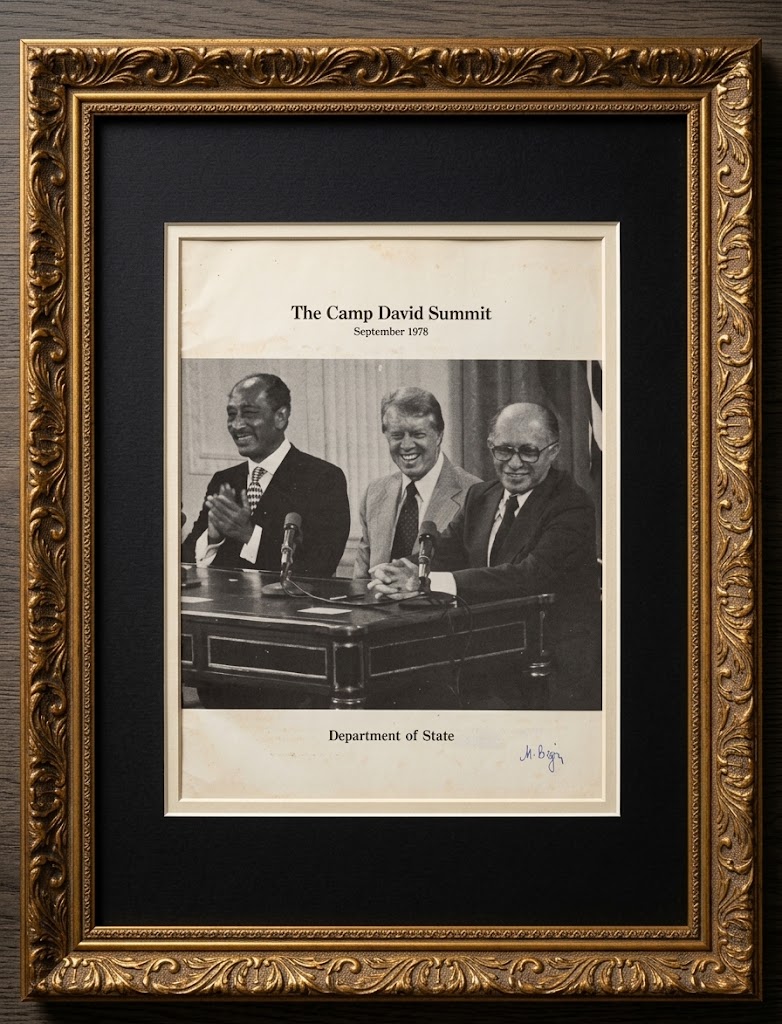
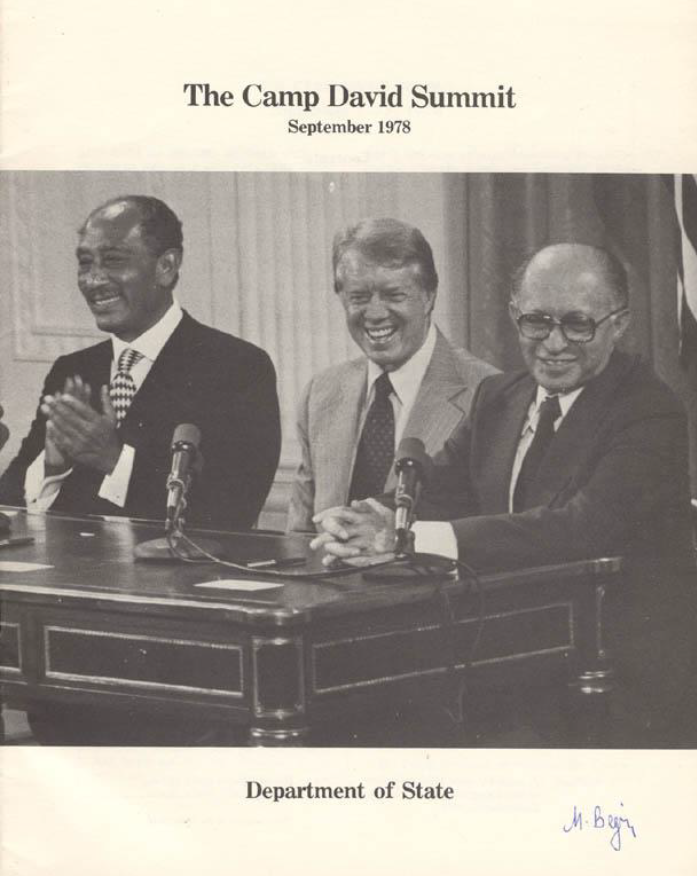
History does not remain only in memoirs. We are proud to present a powerful and rare item that freezes the moment when everything changed: a 19-page booklet (measuring 8×10½ inches) published by the U.S. Department of State titled “The Camp David Summit”. The booklet contains the text of the “Framework for Peace in the Middle East” of September 17, 1978, associated documents, and the text of U.S. President Carter’s address to Congress of September 18.
The cover features a black-and-white photograph (measuring 8×6½ inches) of Begin, Sadat, and Carter in a moment of historic agreement. Just beneath this photograph, the original signature of the Prime Minister is prominently displayed: “M. Begin”. The booklet has been preserved in Fine condition and serves as living testimony from those fateful days.
To see and touch this item today, 47 years later, is to feel the wings of history and the immense price of true leadership that decided to change the Middle East forever.
Farkash Gallery wishes all the people of Israel and Jews everywhere around the world a Gmar Chatima Tova (May you be inscribed in the Book of Life) and an easy fast.
Yours, Aharon Farkash The Farkash Gallery
Sorry, the comment form is closed at this time.