

22 Nov Ben-Gurion, Zionism and Religion: The Debate That Never Ended
Nothing New Under the Sun
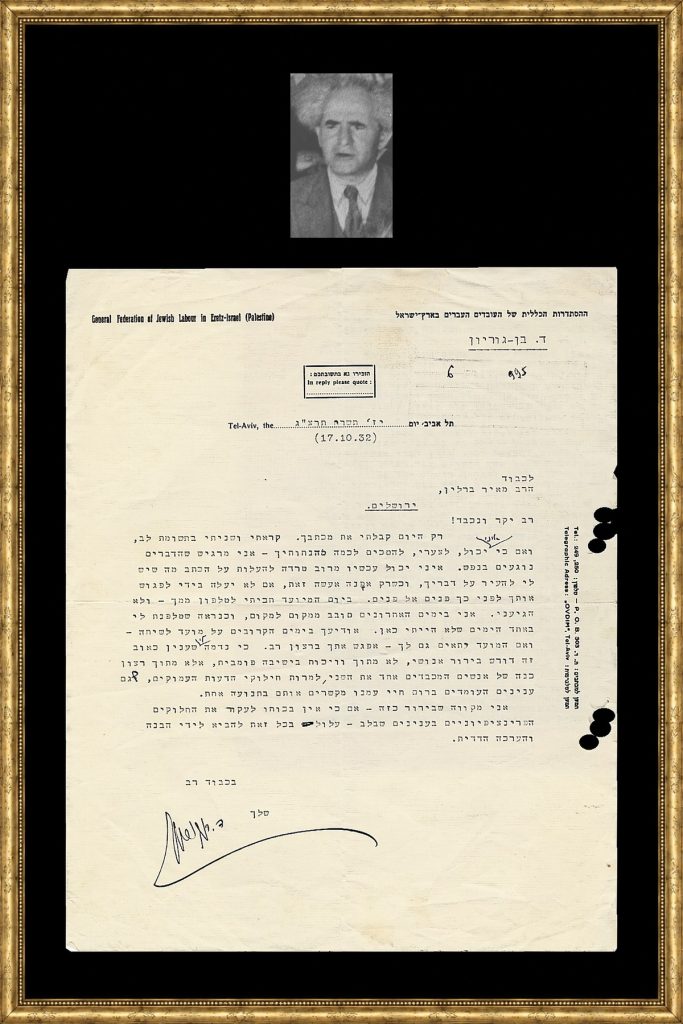
An extremely rare find, a letter by Ben-Gurion from 1932.
THE FARKASH GALLERY IS PROUD TO PRESENT
Jerusalem and Tel Aviv, autumn 1932. The country is British Mandate Palestine: Britain governs under a League of Nations mandate, formally committed by the Balfour Declaration to the establishment of a Jewish national home in the Land of Israel. The Jewish community, the Yishuv, is building its institutions, its parties and its economy under the fresh shadow of the riots of August 1929, which reached their peak in the Hebron massacre, where 67 Jews were murdered. The question of what the Yishuv is, and what it should become, burns on every desk.
On one side stands David Ben-Gurion. Born David Grün in Plonsk, Poland, in 1886, he immigrated to the Land of Israel in 1906 and rose to the head of the labor movement: secretary-general of the Histadrut, the General Federation of Hebrew Workers, one of the Yishuv’s central institutions, and leader of Mapai, the Workers’ Party of the Land of Israel, founded in 1930. In 1932, sixteen years before he becomes the first prime minister of the State of Israel, he is one of the labor movement’s central leaders, and his voice carries.
On the other side stands Rabbi Meir Berlin (1880-1949), leader of the world Mizrachi movement. Mizrachi, its name a Hebrew acronym for merkaz ruhani, “spiritual center,” was founded in Vilnius in 1902 as the religious wing of Zionism, under the slogan “the Land of Israel for the people of Israel according to the Torah of Israel.” Where the labor movement spoke of building a new Hebrew society, Mizrachi insisted that the national home must stand on the foundations of Jewish tradition. In 1932, Mizrachi’s man in Jerusalem was Berlin: rabbi, journalist, and one of the central figures of religious Jewry in the Land.
At a meeting of the Vaad Leumi, the Jewish National Council, Ben-Gurion leveled a sharp accusation: the views of the Mizrachi representatives were not accepted, and their influence was not felt within the national movement, because they sinned in matters “between man and his fellow man,” in their ethical conduct toward others.
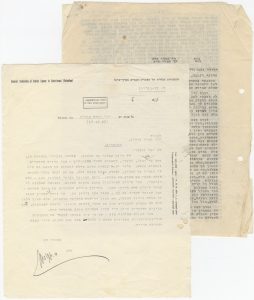
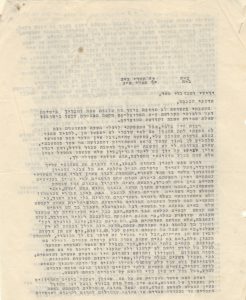
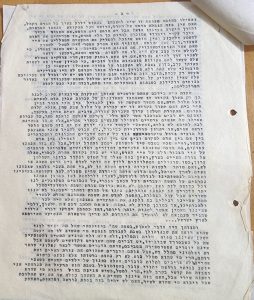
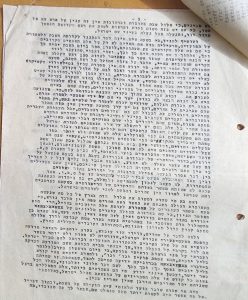
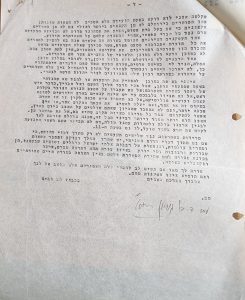
Rabbi Berlin, who sat in that meeting, promptly answered with a four-page typewritten letter. Even if Ben-Gurion were right about some Mizrachi members, he argued, that could never disqualify the voice of the movement as a whole:
“Have we not read and heard and seen that even under the mask of unity, equality, freedom and liberty, men murdered and plundered? And because of such wicked men who corrupted them, are the good, sincere and worthy ideas themselves to be rejected?”
(translation from the Hebrew: ״והאם לא קראנו ולא שמענו ולא ראינו כי גם תחת מסוה האחדות והשויון והחופש והחרות היו הורגים אנשים וחומסים, וכי בשביל רשעים כאלה שקלקלו, פסולות הדעות הטובות והכנות והרצויות?״)
Berlin does not stop at defense. In the body of his letter he answers accusation with accusation: he points to “the number of those who transgress the tradition” (מספר העוברים על מסורת) in the other camp, to those who “caused a split” (שגרמו לפרוד) and to what he calls “the desecration of religion in the Land” (חילול הדת בארץ). The rift, he writes, divides one people “into two nations in Israel” (לשני לאומים בישראל).
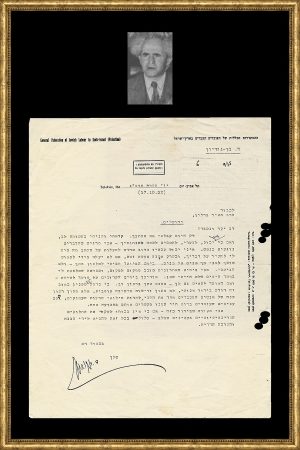
Ben-Gurion’s reply, the letter offered here, dated 17 Tishrei 5693 / October 17, 1932, on official Histadrut letterhead and signed by his hand, is strikingly personal. He apologizes that he cannot put everything in writing:
“I feel that these matters touch the soul.” (אני מרגיש שהדברים נוגעים בנפש)
And he asks to meet face to face instead:
“For it seems to me that this painful matter calls for a humane clarification, not through debate in a public meeting, but through the sincere desire of people who respect one another, despite their profound differences of opinion, whom the issues standing at the very summit of our people’s life unite within one movement…”
(translation from the Hebrew: ״כי נדמה שענין כאוב זה דורש בירור אנושי לא מתוך ויכוח בישיבה פומבית אלא מתוך רצון כנה של אנשים המכבדים אחד את השני, למרות חילוקי הדעות העמוקים, ענינים העומדים ברום חיי עמנו מקשרים אותם בתנועה אחת…״)
Ninety-four years later, we read this correspondence with a jolt of recognition. The 1932 exchange concerned the religious-Zionist Mizrachi, a different camp from today’s Haredi parties, and military conscription was not its subject. Yet its spirit is unmistakably alive in Israel’s current debates over Haredi conscription and over religion and state: the same mutual accusations, the same struggle over the place of tradition in the life of the nation. As Ecclesiastes said, there is nothing new under the sun.
The Farkash Gallery is proud to present this rare correspondence: Ben-Gurion’s hand-signed reply, together with Rabbi Berlin’s original four-page typewritten letter.
Sorry, the comment form is closed at this time.