

07 Dec Await the Altalena on the Tel Aviv Shore, 1948
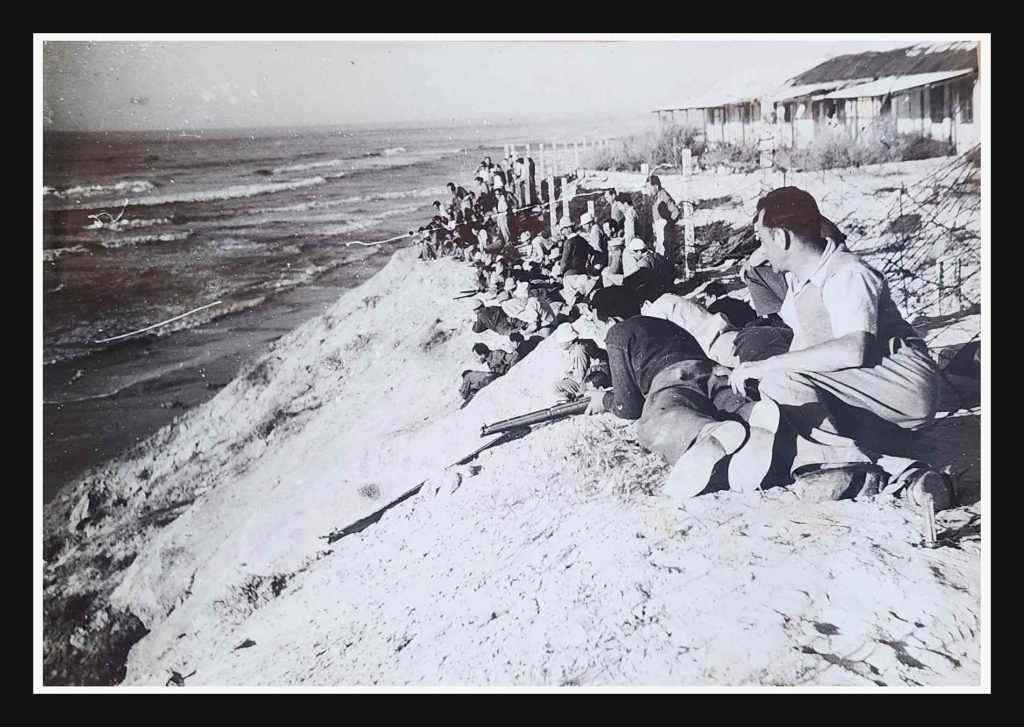
Rare Historical Photograph: Haganah Soldiers—Later the IDF—Await the Altalena on the Tel Aviv Shore, 1948
Size: approx. 18 × 13 cm (7.0 × 5.1 inches) — Framed, original period print
This rare historical photograph shows a line of Haganah soldiers, standing alert on the Tel Aviv beach, rifles in hand — prepared to open fire on the Altalena should the ship refuse to surrender to the demands of the provisional government.
These were the tense moments just before the Altalena approached the shoreline, minutes before the confrontation that would become one of the most painful crises in Israel’s early history.
According to attribution common in Revisionist circles, the first figure on the left is believed to be Yitzhak Rabin, then a young officer in the Harel Brigade.
The Altalena – The Voyage, the Immigrants, the Weapons, and the Eruption of Conflict
The Altalena was purchased by the Irgun and operated with a dual mission:
Bringing Holocaust survivors to Israel
On board were approximately 940 passengers, many of them survivors newly released from displaced-persons camps in Europe.
Delivering a massive weapons shipment The ship carried: 5,000 rifles Hundreds of machine guns Mortars Millions of rounds of ammunition Additional critical military supplies
This arsenal was intended to reinforce the Irgun fighters, especially in besieged Jerusalem — a move which, many argue, could have significantly changed the military balance.
The confrontation reaches its peak in Tel Aviv
After anchoring at Kfar Vitkin and as tensions escalated between the provisional government and the Irgun, IDF (Haganah) forces were ordered to prevent the unloading of weapons at all costs.
The ship proceeded south to Tel Aviv, where two forces now stood face to face: On the shore: armed Haganah/IDF soldiers, ready to fire. On the ship: Irgun fighters, commanders, and immigrants. This is the moment captured in the photograph.
Ben-Gurion and the Order to Open Fire – A Decision that Became a National Wound
David Ben-Gurion viewed any weapons unloading outside the control of the newly formed IDF as a threat to the sovereignty of the new state.
In the Revisionist view, the decision was also politically motivated to weaken the Irgun as an independent force. His order was unequivocal: Prevent the unloading of the weapons — even at the cost of firing on Jews.
Rabin – His Role, the Shooting, and the Controversy That Still Echoes
According to the Revisionist narrative: Rabin was among the central officers who carried out the order to open fire.
Shots were directed not only at Irgun fighters on the shore, but also at those who had already jumped into the water after abandoning the burning ship. The claim regarding Rabin’s own words
There is a widely circulated belief in Revisionist circles that during his tenure as Israel’s ambassador in the United States, Rabin said that he had also fired at Irgun fighters who were in the water.
Rabin in the eyes of Revisionists Because of his involvement in the shooting, Rabin has been regarded by many Revisionists as a traitor, one who turned his weapon against fellow Jews during the War of Independence.
The confrontation resulted in 14 dead and dozens wounded — a moment that nearly ignited a civil war.
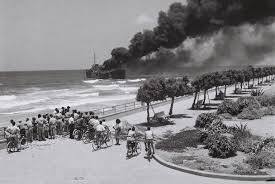
Many in the Revisionist camp view the Altalena affair as one of the most dangerous moments in Israel’s early history—
a moment when the newly formed IDF aimed its weapons at Jewish fighters. While armed Haganah/IDF forces stood on the shore ready to fire at Irgun fighters and the immigrants aboard the ship, Menachem Begin stood on the opposite side and demonstrated exceptional leadership. In the eyes of many, the order to fire on Irgun men brought about tragic bloodshed—
and it was Begin who prevented the collapse into civil war, effectively saving the young State of Israel from an internal explosion that could have threatened its existence.
Even as fire was opened on Irgun fighters, including those already in the water, Begin cried out with all his strength: “There will be no civil war!”
He instructed his men not to return fire—even when their own lives were in danger.
In this way, Begin became, for many, the man who stood between Israel and a destructive internal war, preventing the disintegration of the IDF and the newly born state in its earliest days.
The Chronological Story of Menachem Begin and the Altalena The journey of the Altalena—and Menachem Begin’s role in it—is one of the most dramatic and emotionally charged episodes in Israeli history.
Below is the story as it unfolded, step by step:
1. The Ship Is Purchased — Begin Plans to Rescue Jerusalem
As commander of the Irgun, Begin took part in the decision to purchase the Altalena and load it with a massive weapons shipment, intended primarily for the besieged Jewish forces in Jerusalem.
For him, it was a national mission: to save Jewish fighters and strengthen the defense effort.
2. Begin Boards the Ship in France
During the preparations for departure, Begin joined his men and boarded the ship in the port of Sète, France, together with volunteers and hundreds of Holocaust survivors.
For him, this was a voyage of rescue and national duty.
3. The Voyage to Israel — Begin Refuses to Split the Irgun
During the voyage, the new state was being formed and the IDF was being established.
Begin wanted to hand over most of the weapons to the IDF, but insisted that part of the shipment be sent to Jerusalem, where many Irgun fighters were battling with severe shortages.
This disagreement laid the groundwork for the escalation to come.
4. Arrival at Kfar Vitkin — The Crisis Erupts
The ship anchored first at Kfar Vitkin.
Begin disembarked to negotiate with representatives of the Haganah.
Talks broke down after a clear order was issued from above:
No weapons were to be unloaded outside IDF authority.
5. Begin’s Famous Declaration — “There will be no civil war!”
As tensions rose and initial gunfire broke out, Begin proclaimed publicly:
“There will be no civil war. Do not return fire!”
This became his unwavering stance throughout the entire crisis — even at immense personal and political cost.
6. The Altalena Heads to Tel Aviv — Begin Moves Along the Coast
The ship sailed south in search of a safe place to unload.
Begin moved along the shore with his men, trying to reorganize and prevent further deterioration.
7. The Battle in Tel Aviv — Begin Returns to the Burning Ship
When full-scale shooting erupted near the Tel Aviv coastline, including fire directed at men in the water, Begin made a dramatic decision:
He went back onto the ship, even as it was already in flames.
He risked his life knowingly — solely to prevent the Irgun from returning fire.
He called out:
“Comrades, even if they shoot at us — do not shoot back!”
This act is remembered as one of the most extraordinary moments of leadership in Israeli history.
8. Begin Prevents a Civil War
In the midst of chaos and flames, Begin succeeded in stopping his men from firing at IDF soldiers.
Without this decision, Israel could have plunged into a full-scale civil war — in the middle of its War of Independence.
9. After the Event — Begin Carries the Wound for Life
Begin never attacked the IDF, even after the shooting.
He viewed national unity as a supreme value.
The trauma of the Altalena accompanied him and shaped his political and personal path for decades.
Who Was on the Ship?
On the Altalena were: Experienced Irgun fighters New immigrants and Holocaust survivors Senior Irgun commanders, including Captain Eliyahu Lankin
-
A weapons cargo that could have altered the battle for Jerusalem
The Photograph – An Original Work by Benno Rothenberg
This photograph was taken by Benno Rothenberg, one of the most important photographers of the pre-state and early statehood era.
About Rothenberg
-
Documented battles, daily life, political struggles, and underground movements.
-
Known for precision, courage, and his presence on the front lines in historical moments.
-
His photographs appear in major museums, archives, and private collections worldwide.
-
He captured events as they unfolded — raw, unedited, and historically vital.
Authenticity of the Print
On the back of the photograph appears Rothenberg’s original studio stamp, and the print itself is:
✔ An original period print from the time of the event
✔ Not a reproduction or modern copy
It is an authentic visual document from the moment when the Jewish community stood on the brink of profound internal conflict.
Sorry, the comment form is closed at this time.