

15 Aug “Dreyfus is Innocent!”
“Dreyfus is Innocent!”: The Poster That Cried Out the Truth, Tore France Apart, and Birthed Zionism
In the late 19th century, France was torn in two. In the streets of Paris, in cafes, in parliament, and within families, a fierce and violent struggle raged over a single question: Is Captain Alfred Dreyfus guilty or innocent?
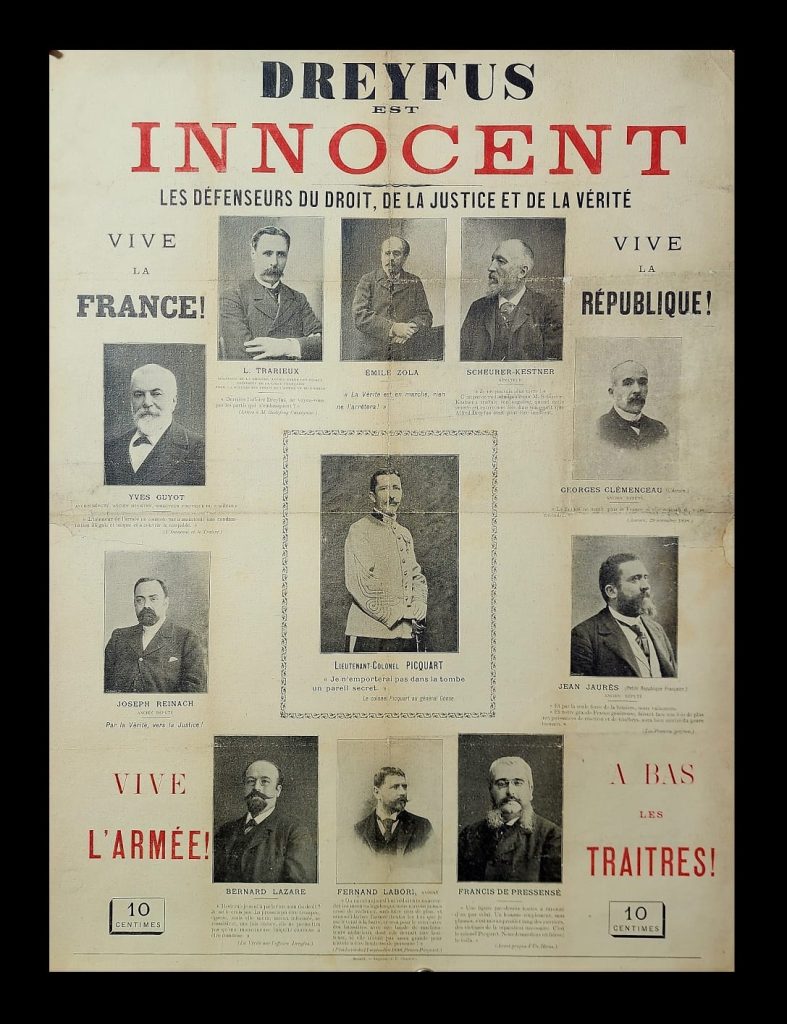
The fascinating historical artifact currently displayed in our gallery—the original “Dreyfus is Innocent” (Dreyfus est innocent) poster from 1898—is much more than an old print. It is a rare, living testament to the moment a group of intellectuals, politicians, and military officers decided to risk their lives and status for justice, standing tall against a murky wave of antisemitism and institutional corruption.
The Modern Blood Libel: How It All Began
In 1894, Alfred Dreyfus, a brilliant Jewish artillery officer in the French General Staff, was arrested on suspicion of espionage. France at the time was licking its wounds after its defeat in the Franco-Prussian War, and the public atmosphere was heavily saturated with paranoia and nationalism. Suspicion fell on Dreyfus following the discovery of a missive (the “bordereau”) written to the German embassy, which detailed French military secrets.
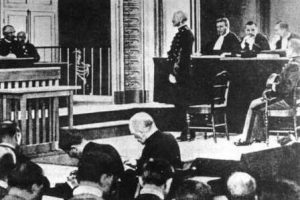
Despite a glaring lack of concrete evidence, and though the handwriting did not definitively match his own, Dreyfus’s Jewish heritage made him the perfect scapegoat. His trial was held behind closed doors, and he was sentenced to life imprisonment on a small, isolated island in French Guiana—”Devil’s Island.”
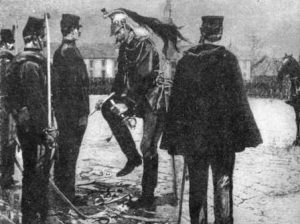
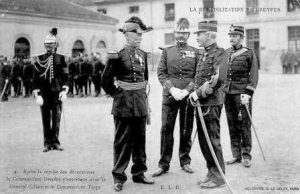
In January 1895, in the courtyard of the École Militaire in Paris, a public degradation ceremony was held for Dreyfus. His rank insignias were violently torn from his shoulders, his sword was broken, and an incited mob outside the gates shouted: “Death to the Jews! Death to the traitor!” Dreyfus himself shouted back: “I am innocent! Vive la France!”
The Broadside: “Le Siècle” Newspaper Goes on the Offensive
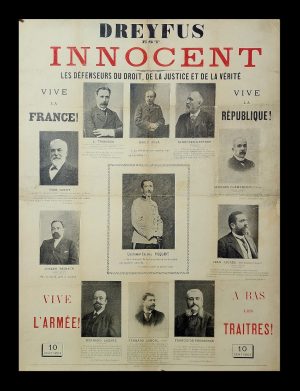
The extremely rare poster in our possession (measuring 64×46 cm) was printed around 1898 at the E. Charaire printing house. It was commissioned and published by the prestigious French newspaper “Le Siècle” (The Century), which served as one of the most prominent voices of the “Dreyfusard” (pro-Dreyfus) camp.
This poster was not created in a vacuum. During those turbulent days, a venomous, antisemitic poster titled “Dreyfus is a Traitor” (Dreyfus est un traître) was being widely distributed across France. The editors of Le Siècle decided to fight back, printing this powerful counter-poster distributed as a special free supplement to its readers. The goal was clear: to show the public that the men defending Dreyfus were not “traitors” or “enemies of the Republic,” but rather the moral, intellectual, and military elite of France—heroes of truth and justice.
The Heroes on the Wall: Who is Featured?
The broadside features 11 portraits of the central figures in the struggle to clear Dreyfus’s name. Below each portrait is a famous quote from that figure. Among the featured personalities:
-
Lieutenant-Colonel Georges Picquart (Center): The courageous intelligence officer who discovered the truth—the real traitor was a debt-ridden French officer named Ferdinand Walsin Esterhazy. When Picquart presented his findings to his superiors, they ordered him to stay silent to avoid embarrassing the army. His response, featured on the poster: “I will not take such a secret to the grave with me.” In retaliation, the army reassigned Picquart to a dangerous post in Tunisia.
-
Émile Zola: The French literary giant who, in January 1898, published the seminal article “J’Accuse…!” (I Accuse…!). The publication led to a libel trial against Zola himself but successfully escalated the affair from an internal military cover-up into an international crisis. His quote on the poster: “Truth is on the march, and nothing shall stop it!”
-
Georges Clemenceau: A renowned journalist and politician (and later Prime Minister of France), whose newspaper, L’Aurore, published Zola’s open letter and provided its famous headline.
-
Bernard Lazare: A Jewish publicist and historian, and the very first to publish a public defense of Dreyfus back in 1896, despite severe threats to his life.
-
Fernand Labori: The brilliant defense attorney who represented Émile Zola, and later Dreyfus himself. During Dreyfus’s second trial, he was shot in the back in an assassination attempt, yet he survived and bravely returned to the courtroom.
-
Jean Jaurès: The leader of the French socialist movement, who viewed the Dreyfus trial as a fundamental struggle for human rights and justice against corrupt militarism.
Alongside them are other prominent politicians and public figures such as Auguste Scheurer-Kestner, Yves Guyot, Joseph Reinach, L. Trarieux, and Francis de Pressensé. At the bottom of the poster, a sharp text cries out in bold red: “A BAS LES TRAITRES!” (Down with the Traitors!), a call directed this time not at Dreyfus, but at the corrupt officers who forged the evidence against him.
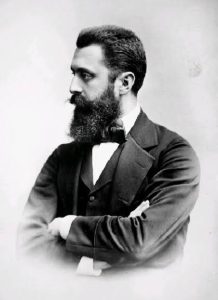
The Bystander Who Changed History: Theodor Herzl and the Birth of Zionism
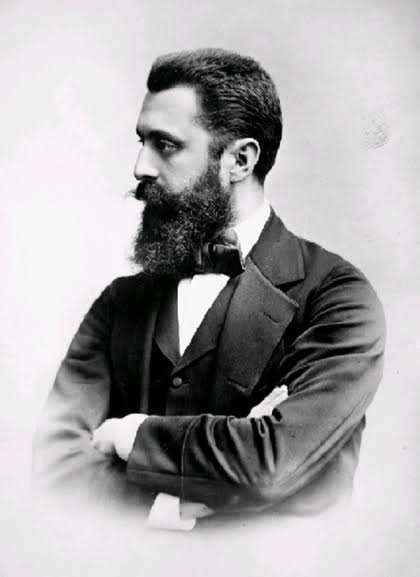
The Dreyfus Affair didn’t just change France; it irrevocably changed the destiny of the Jewish people. In the crowd of reporters standing in the freezing cold covering Dreyfus’s degradation ceremony in January 1895 stood a secular Austro-Jewish journalist, the Paris correspondent for the Viennese newspaper Neue Freie Presse. His name was Theodor Herzl.
For Herzl, the sight of a French mob—in the global capital of liberty, equality, and enlightenment—screaming “Death to the Jews” was a breaking point that shattered his worldview. Until that day, many educated Jews (including Herzl himself) believed that integration and assimilation into European society were the ultimate solutions to antisemitism. Alfred Dreyfus was the very symbol of this integration: a French patriot, highly secularized, and an outstanding military officer. His tragic fall proved to Herzl that emancipation had failed.
This profound realization led Herzl to write his visionary book The Jewish State (Der Judenstaat) and to convene the First Zionist Congress in Basel in August 1897. The Dreyfus Affair served as the primary catalyst for the shift from ideological Zionism to practical, political Zionism.
Epilogue: The Delayed Victory of Truth
Public pressure—of which posters like this were a vital instrument—eventually took its toll. In 1899, Dreyfus was brought back from Devil’s Island for a retrial in the city of Rennes. The public was certain of his imminent acquittal, but to the world’s shock, the military tribunal refused to admit its mistake and convicted Dreyfus once again, this time with so-called “extenuating circumstances.”
However, the French government realized the affair was tearing the country apart from within. French President Émile Loubet offered Dreyfus a pardon. Physically and mentally broken from years of horrific isolation and torture, Dreyfus accepted the pardon to return to his family, even though accepting it technically constituted an admission of guilt.
His fight to completely clear his name continued. It wasn’t until July 12, 1906, that the French Supreme Court fully overturned the verdict, cleared his name entirely, and declared his absolute innocence. Dreyfus was reinstated in the army, awarded the Legion of Honor, and even served France loyally during World War I, concluding his military service at the rank of Lieutenant-Colonel.
Curator’s Summary: The “Dreyfus is Innocent” poster is a rare piece of history that encapsulates the struggle for the soul of Europe, the bravery of individuals standing against a rotten system, and the spark that ignited the establishment of the State of Israel. A photograph of this exact poster design is documented in professional historical literature (appearing as image No. 8.5 on page 147 in the book The Dreyfus Affair, published by the Dreyfus Affair Centennial Committee in 1994).
The existence of such an original copy today in well-preserved condition—professionally linen-backed on canvas to ensure the structural stability of the fragile 19th-century paper and protect it for generations to come—makes it an invaluable museum-quality asset for Judaica and history collectors worldwide.
Sorry, the comment form is closed at this time.