

 Vintage Israeli Election 2 Posters – 1996 Benjamin Netanyahu First Victory Campaign
15 Mar 1996 – Netanyahu’s First Victory That Changed Israeli Politics
From Poster to Power: The 1996 Election That Changed Israel – Netanyahu’s Rise and the Beginning of a New Middle East Era
In 1996, Israel experienced one of the most dramatic elections in its history. For the first time, the country introduced direct elections for Prime Minister, allowing voters not only to choose a party for the Knesset but also to vote directly for the head of government. Running against the incumbent Prime Minister Shimon Peres, the relatively young leader of Likud, Benjamin Netanyahu, headed the joint list Likud–Gesher–Tzomet.
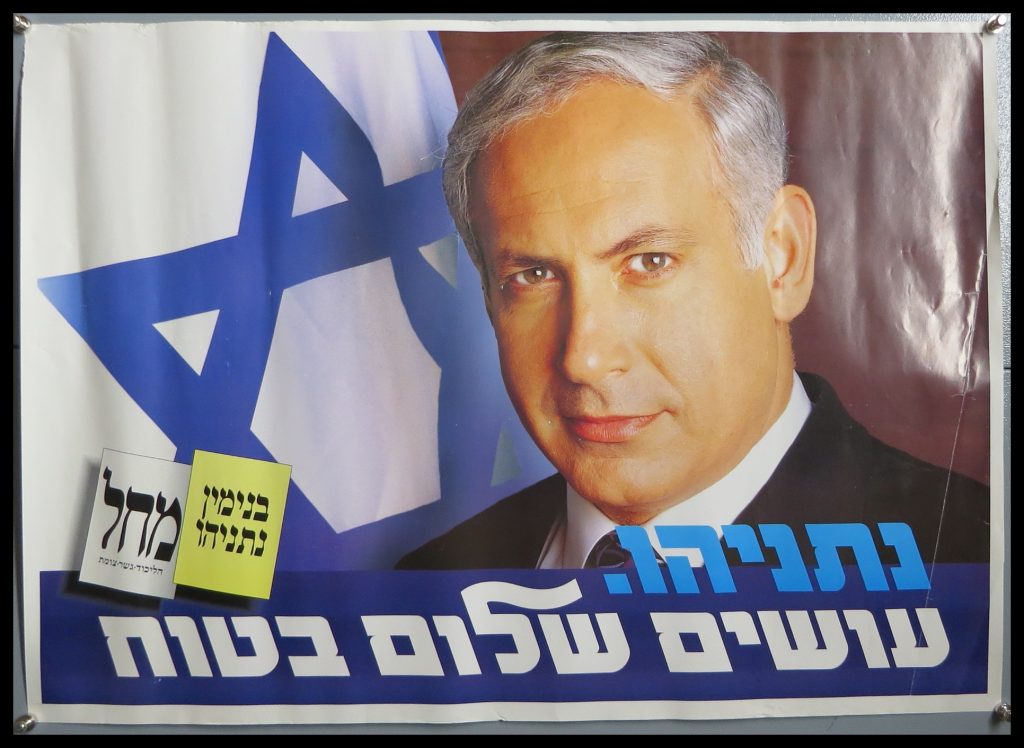
The election took place during a tense and complex period in Israeli society. The years following the Oslo Peace Process were marked by hopes for peace but also by waves of terrorist attacks and deep public debate about Israel’s political and security direction. Netanyahu’s campaign emphasized the need to combine diplomatic efforts with strong national security, expressed in the central campaign slogan: “Netanyahu – Making a Secure Peace.”
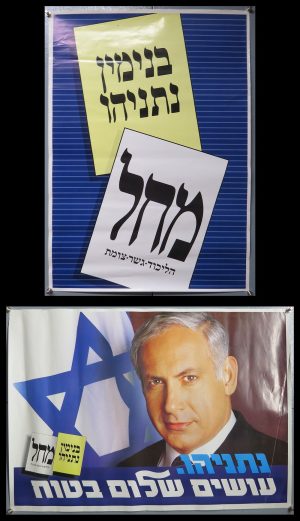
The two posters shown here capture the spirit of that campaign. One poster features a large portrait of Netanyahu set against the Israeli flag, with the slogan “Netanyahu: Making a Secure Peace.” The design uses strong blue-and-white national colors and symbolic imagery to convey leadership, stability, and national responsibility. The second poster focuses on the ballot slip itself and reads “Benjamin Netanyahu” alongside the Hebrew letters “מחל” (Machal), which were the official ballot letters for the Likud–Gesher–Tzomet list. The graphic design resembles voting slips placed on a table, visually reminding voters which ballot to choose at the polling station.
The election was extremely close, but Netanyahu ultimately won and became the youngest Prime Minister in Israel’s history. His victory marked a turning point in Israeli politics and introduced a new generation of leadership to the national stage.
Benjamin Netanyahu has since become one of the most influential and enduring figures in Israeli politics. Born in 1949, he spent part of his youth in the United States and served in the elite Sayeret Matkal unit of the Israel Defense Forces. After his military service he pursued academic studies and a diplomatic career, later serving as Israel’s ambassador to the United Nations. His rhetorical skills, fluent English, and ability to articulate Israel’s position on the global stage quickly made him a prominent figure in the 1980s.
Over the years Netanyahu has held several key positions, including Member of Knesset, Minister of Foreign Affairs, Minister of Finance, and Prime Minister in multiple terms. Throughout his political career he has been associated with policies emphasizing national security, economic liberalization, technological development, and strengthening Israel’s international alliances. During his leadership, Israel expanded diplomatic ties with many countries and continued to grow as a global center of innovation and high technology.
At the same time, Netanyahu has also been one of the most controversial figures in Israeli politics. His leadership has inspired strong support as well as significant criticism. Supporters view him as an experienced and determined leader committed to safeguarding Israel’s security and strengthening its global position, while critics point to political and public controversies surrounding his tenure.
For many years Netanyahu repeatedly warned the international community about the growing strategic threat posed by Iran and its nuclear ambitions. He argued that a nuclear-armed Iran would fundamentally change the balance of power in the Middle East and pose a grave danger to Israel and the wider region. These warnings became a central theme of his speeches on the global stage, including at the United Nations, where he often spoke about the need to prevent Iran from obtaining nuclear weapons.
In the eyes of his supporters, these long-standing warnings demonstrate his strategic outlook and persistence in raising the issue even when it was controversial internationally. Today, in light of ongoing regional tensions and developments surrounding Iran’s nuclear program, many see those early warnings as part of a broader strategic debate that continues to shape Middle Eastern politics.
These 1996 election posters are therefore more than political campaign materials; they are historical artifacts from a pivotal moment in Israeli political history — the beginning of a long and influential era in the leadership of one of the country’s most prominent figures. Many of his supporters as well as some of his opponents acknowledge that his impact on Israel’s policies and political direction has been profound. Supporters believe that the policies and initiatives he has led are influencing not only Israel but the broader region, reshaping the Middle East, and they hope these developments will ultimately lead to a new era of stability, security, and opportunity
Sorry, the comment form is closed at this time.