

29 Aug Menachem Begin’s Testament of Unity Following the Raising of the “Altalena”
From the Depths of the Sea to the Chasms of Division: Menachem Begin’s Testament of Unity Following the Raising of the “Altalena”
Before the State of Israel was born, it nearly tore itself apart. But Menachem Begin — known as a radical, a zealot, and even a danger — chose unity over vengeance, making the gut-wrenching decision to stop Jews from turning their guns on each other, even as bullets flew and ships burned.
From the Depths of the Sea to the Light of Day: The Ship’s Remains and the Historic Letter
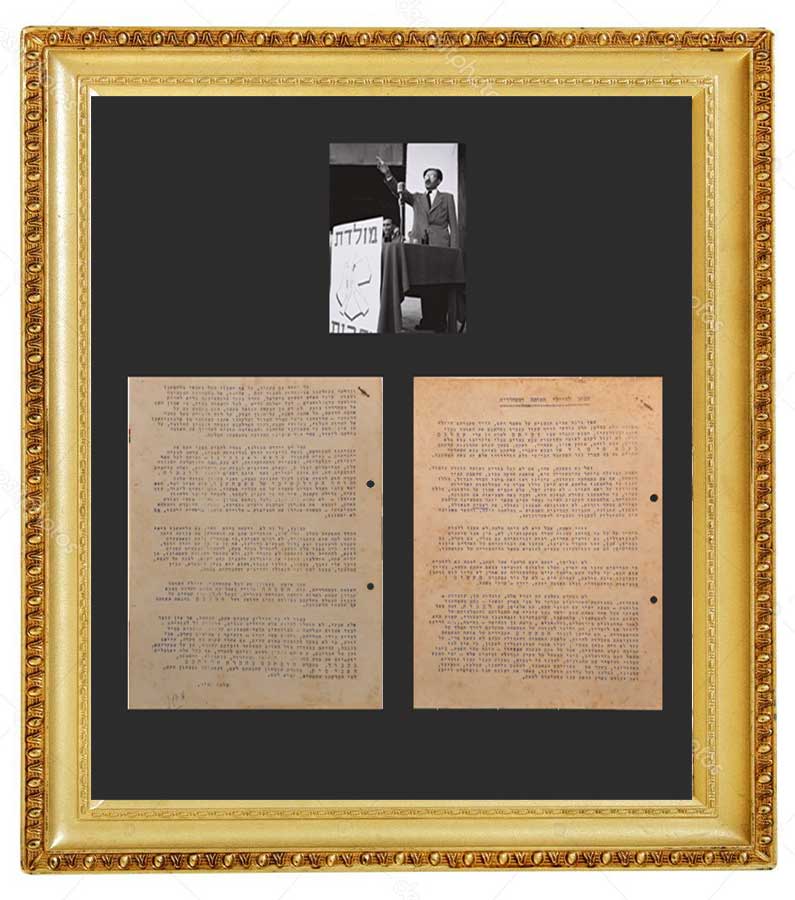
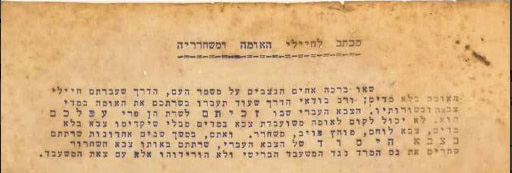
The raising of the Irgun ship Altalena from the depths of the Mediterranean Sea and the bringing of its remains to the surface in recent days is far more than a complex maritime or archaeological recovery operation; it is a physical and metaphorical resurfacing of the most painful, defining wound in the history of the young State of Israel. As the deep waters yield the scorched iron hull, a rare, poignant historical document from those exact days takes on renewed resonance: yellowed, typewritten pages titled “A Letter to the Soldiers of the Nation and Its Liberators”, signed at the bottom with the moving words “Yours always,”by the Irgun commander: “Menachem Begin”.
Written in the summer of 1948 and published in Herut—the bulletin of the underground that transformed into a political movement—the letter stands as testament written from the very heart of a leader standing on the edge of the abyss of civil war, choosing resolutely to pull his people back from the brink.
The Shadow of the “Holy Cannon” and the Civil War That Was Averted
In June 1948, just weeks after the declaration of independence, Israeli society was torn apart by one of the most agonizing crises in its history. The arrival off the coast of Tel Aviv of the Altalena, laden with weapons and immigrant recruits, led to a direct confrontation with the Provisional Government headed by David Ben-Gurion, who ordered its shelling.
The shells from the “Holy Cannon”—the phrase coined by Ben-Gurion that remains etched into the bedrock of national division—claimed the lives of 16 Irgun fighters and three IDF soldiers. As the ship went down in flames and fury among the Irgun ranks threatened to ignite a bloody retaliation, Begin demonstrated superhuman restraint. Over the underground radio, his voice choking with tears, he issued the absolute command: “Civil war—never!”. Begin understood that a violent internal triumph would mean the total ruin of the newly reborn Third Commonwealth.
Begin’s Greatness: Brotherly Unity Above All Division
The historical stature and moral depth of Menachem Begin were revealed in their fullest power precisely during these agonizing moments of trial and rupture. Faced with live fire, institutional delegitimization, mass arrests, and deep personal and political humiliation, Begin refused to adopt the language of revenge or place his own honor and the righteousness of his camp above the survival of the state. His principle of “Brotherly Unity” (Ichud HaAchim) was no mere slogan; it was a supreme existential imperative and a moral backbone. Begin showed extraordinary leadership through forbearance and national responsibility—swallowing bitter humiliation, ordering his fighters to submit to the sovereign national military, and ensuring that even in the eye of the storm, the Jewish people remained united and did not repeat the fatal errors of their past.
“The Official Pen” and the Battle for Historical Truth
In the typewritten letter, Begin confronts the establishment’s attempt to erase the underground fighters from the narrative of national liberation. Addressing his former subordinates who had donned IDF uniforms, he affirms their foundational role:
“The path you have walked… the Hebrew Army you have been privileged to serve is the fruit of your labor. An army in uniform cannot arise for an enslaved nation without an army without uniforms preceding it.”
Begin forcefully challenges the official narrative that portrayed the British withdrawal as mere coincidence:
“Let the official pen write what it will. Let it try to prove that the British left the land, ended their rule, and withdrew their army ‘just like that’… Deeds are not written on paper; they are known in historical reality and in the heart of the nation.”
Yet alongside his demand for historical justice, Begin presents an inclusive vision, refusing to claim exclusivity over the victory:
“We claim no monopoly. Other factors, too, have great merits in the revolt, in battle, and in building. Indeed, this is the difference between us. We do not deny the merits of others; they seek to erase our merits from the history book of our era.”
“Even After the Storm of What Happened”: Heroism Under Scorn
On the second page of the letter, Begin refers directly—in restrained yet deeply resonant words—to the trauma of the Altalena and the ultimate test of national loyalty:
“I know that your place was not absent from any battle line, even after the storm of what happened; as known at Negba, you stood with bravery before the charging enemy…”
The phrase “after the storm of what happened” is a direct reference to the Altalena tragedy and the arrests that followed. Despite the heartbreak, the insult, and being fired upon by their brethren, the Irgun fighters did not abandon the cause. They reported to the southern front at Kibbutz Negba against the invading Egyptian army, proving that allegiance to the nation superseded any political grievance.
From the depths of this fracture, Begin issues a call to build the state together:
“Brick by brick, layer upon layer, we shall build. All of us together. And it shall be a magnificent building, a sovereign building, from which the message of political and social redemption alike shall go forth.”
From the Lessons of the Great Revolt to Today’s Fractures
Begin’s historical consciousness was deeply rooted in the memory of the Great Revolt against Rome and the destruction of the Second Temple. He knew well that Jerusalem fell not merely under the battering rams of the Roman legions, but primarily because of internal fanaticism, baseless hatred, and the burning of food storehouses by rival factions within the city walls. Two thousand years of exile had branded into him an unyielding lesson: no political victory justifies brotherly strife.
Today, as the remains of the Altalena are recovered from the seabed while Israeli society once again grapples with profound polarization and internal discord, Begin’s letter transforms from an archival relic into an urgent living testament. The recovery of the Altalena serves as a stark reminder of the devastating cost of political blindness, while Begin’s words—“Brick by brick, layer upon layer… all of us together”—remain an enduring call that the only viable triumph for this nation is the triumph of unity and mutual responsibility.
Full English Translation of the Historic Document
[Page 1]
A Letter to the Soldiers of the Nation and Its Liberators
Receive blessings, brothers standing guard over the nation, on the path you have walked as soldiers of the army in uniform; and the Hebrew Army you have been privileged to serve is the fruit of your labor. An army in uniform cannot arise for an enslaved nation without an army without uniforms preceding it—a fighting army, crushing the enemy, liberating. And you, for several years, served in the foundational army of the Hebrew Army; you served in that liberation army which raised the banner of revolt against the British oppressor and did not lower it until the oppressor departed.
Do not be angry, my brothers, if not everyone acknowledges this fundamental fact. The greatest truth in history is that truth is stronger than falsehood, and truth always triumphs, even if its victory is delayed. Our own eyes witnessed this during the days of the Great Revolt. Those critics claimed that our war was a futile war; they said that with the mighty blows we rained upon the head of the enemy we would achieve nothing, but rather bring disaster upon the Yishuv. They claimed that our struggle was devoid of wisdom—yet reality proved where wisdom lay, demonstrating that our consistent, valiant war over a few short years achieved more than the struggle of the islands over generations. We did not chase “illusions”; redemption—the very beginning of redemption—is what we brought. Wisdom, genuine political wisdom, lay in the fighting. The opposite of wisdom lay in adapting to subjugation and waiting for “solutions.”
This is the truth, but it was not complete; we never claimed sole credit for all that was achieved in the honesty of the revolt and in its wake. No, we claim no monopoly. Other factors, too, have great merits in the revolt, in battle, and in building. Indeed, this is the difference between us. We do not deny the merits of others; they seek to erase our merits from the history book of our era.
They will not succeed. Let the official pen write what it will. Let it try to prove that the British left the land, ended their rule, and withdrew their army “just like that.” It is a futile attempt. For alongside the official pen, another pen exists in history; it does not write in ink, and its writing does not fade—it is eternal. Deeds are not written on paper; they are known in historical reality and in the heart of the nation. Known—in both senses of the word.
These words of mine are not spoken in vain. They are facts. Facts—in lines. In recent weeks, I have traveled across the country and come—in the name of our fighting family—into direct contact with the masses of the people. With thousands; with tens of thousands. How deeply I wished that every single one of you could see with your own eyes the outpouring and expression of the people’s feelings toward our family, our struggle, our sacrifices, and our historic victory. It is wrong to say that the crowds in Jerusalem, in Tel Aviv, in Ramat Gan, and in Haifa—in Haifa!—cheered for an individual or his speech. They cheered for the honor of the family that led them onto the high road of history. They cheered for the mighty deeds of that same family that brought them out from bondage to freedom. The work of obscuration and false propaganda yielded no fruit. As long as there was no tangible test, the monopolists could claim that we lacked popular support. But whenever a test occurred, the truth was revealed: in the days of the Jerusalem referendum, in the campaign of the “Iron Fund,” and in these days—the days of open, direct contact with the masses. We learned that tens of thousands from our people stand behind us, for we realized their yearnings; for their sake we fought, suffered, bled, were tortured, fell, and ascended the gallows. Because we continue to represent their will, we continue to bear their destiny in this land.
[Page 2]
So shall it be in the future. Despite all the attempts to obscure the conditions of our war and the ways of our actions, and despite the warnings of ill tongues, the eyes of the masses in Israel look to us, to our steadfast family. The nation trembles with a healthy instinct for the freedom bought with the blood of fighters, lest foreigners seize it, lest it be trampled from within. For the people’s trust in their liberators stems not only from the redeeming deed itself. It is founded also on the love of freedom, the love of truth, the vision of justice, the spirit of creation, and the morality of fulfillment—which we proved during the days of the Great Revolt and carried with us as we emerged from the underground into open ranks, into the army battalions, within the vanguard of pioneer building. Therefore, there is no doubt that our fighting family will continue to guide the nation on its path toward its destiny, which our eyes shall yet see fully realized.
Much labor will be required of all of us to present our detailed program before the people: in foreign policy, in domestic policy, and regarding the social issue—a problem that will stand at the head of our concerns—as well as regarding all other economic, military, and legislative matters. These plans will not be forged in haste. The foundational members can, may, and must build the program, and these foundations are solid and enduring. They cannot, and must not, skip stages. It is necessary to listen to the voice of the movement itself, and to place full faith in the constructive, collective spirit of our family. Vision creates. In the days of the revolt, vision created realities that bordered on the impossible. It will continue to create. We shall surely build, rising above pettiness, a life meaningful in itself, suited to its conditions and to its future vision—not a mere memorial to past wrath, but a life both practical and just. We will find equality, and in the fullness of time, realize it. Creative purity and realistic action—which reshapes reality itself—have accompanied us from the outset of our journey, and they shall not fail.
Of course, all this will not be done in a single day. Our struggle in the days of the revolt also developed stage by stage. Do you remember the beginning? How modest it was compared to what followed. Not many believed that from such modest means would emerge the greatest deeds of our generation. Yet it came to pass. And it happened because we were not afraid to begin with a few, to start specifically with small steps, and to proceed without regard for mockery or the lack of faith around us. So it shall be now. We shall begin. We shall lay the foundations, and the building will surely rise. Brick by brick, layer upon layer, we shall build it. All of us together. And it shall be a magnificent building, a sovereign building, from which the message of political and social redemption alike shall go forth.
Carry, therefore, with pride the flag of our family, soldiers of the nation and its liberators! May the joy of serving in the Hebrew Army dwell in your tents; the joy of fulfilling the obligations of the mission. Be glad in the privilege that fell to your lot in blazing the trail of freedom, and in your share in bringing the nation its first victory.
I have been told that you are good soldiers. I rejoiced, but it is only natural. You could not be anything but good soldiers, devoted to their studies—learning the art of war—disciplined, always ready to assist their comrades, whoever they may be, and above all: courageous in battle. I know that your place was not absent from any battle line, even after the storm of what happened; as known at Negba, you stood with bravery before the charging enemy and earned the admiration of your commanders and your comrades alike. You brought security, and once again you earned recognition, with honor, in recognition of your duty and your deep inner devotion. Through the seal of victory that you bring to the people, and in faith in the victory that is rising, your full reward will come.
Yours always,
Menachem Begin
Sorry, the comment form is closed at this time.