
Shop


Extremely Rare: A Letter from Menachem Begin to the Irgun Fighters in the IDF Following the Altalena Affair (1948) Published in “Herut”, and Signed: “Yours Always, Menachem Begin”
$3,900.00
SOLD
| Artist / Creator | |
|---|---|
| Condition | |
| Size | |
| A | BEGIN, Menachem Begin Speech for the Liberators of the Nation 1948 |
Description
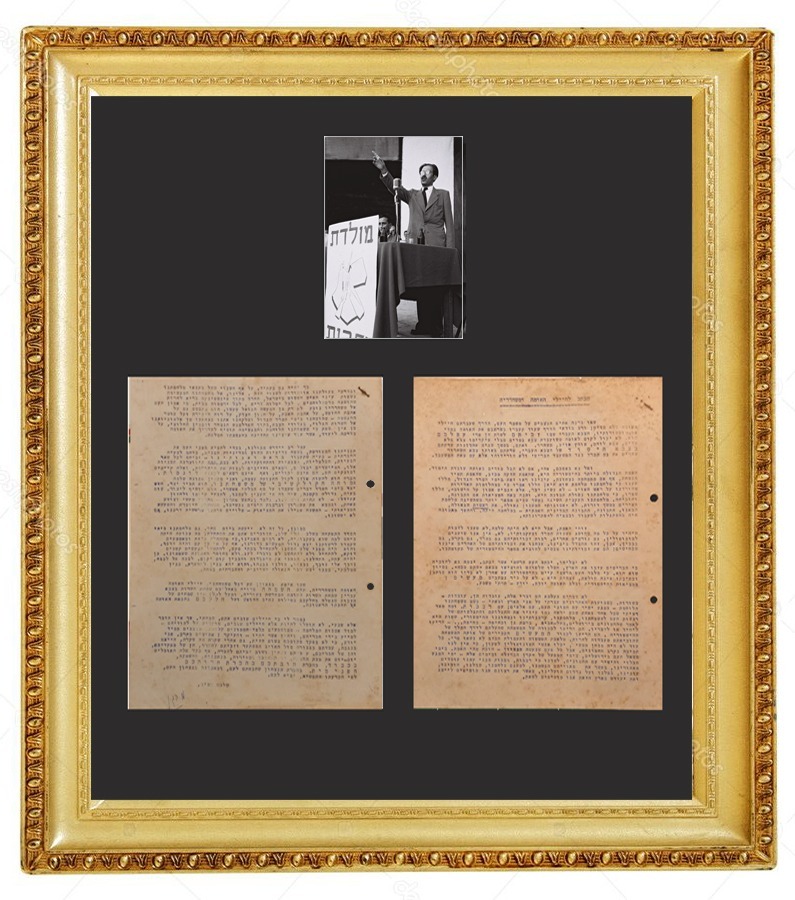
Rare Historic Document (Summer 1948) – “A Letter to the Soldiers of the Nation and Its Liberators” by Menachem Begin | Post-Altalena Affair & Irgun Integration into the IDF | Published in “Herut” Newspaper | Signed: “Yours Always, Menachem Begin”
Before the State of Israel was born, it nearly tore itself apart. But Menachem Begin — known as a radical, a zealot, and even a danger — chose unity over vengeance, making the gut-wrenching decision to stop Jews from turning their guns on each other, even as bullets flew and ships burned.
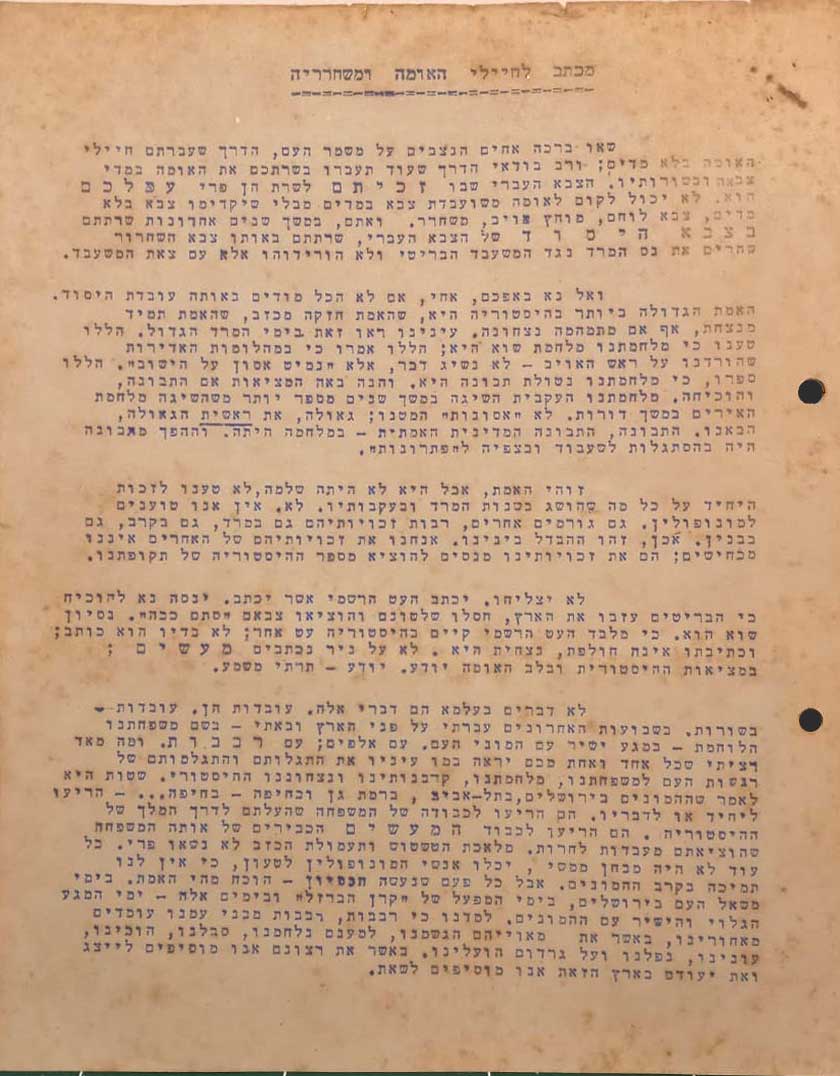
Presented here is a primary historical document of paramount importance, typed letter on two original period pages, published in the summer of 1948 during the height of the War of Independence, and printed in its entirety during that same period in the daily newspaper Herut—the central organ of the movement. This poignant and powerful manifesto, titled “A Letter to the Soldiers of the Nation and Its Liberators”, was sent by Irgun Commander-in-Chief Menachem Begin to his former subordinates who had shed their underground garments to serve as regular soldiers in the newly established Israel Defense Forces. The letter was composed at one of the most fraught and critical crossroads in the nation’s history—immediately following the bloody tragedy of the Altalena affair, its shelling off the coast of Tel Aviv, and the mass arrests that ensued, an event that brought the young Israeli society to the brink of civil war.
In eloquent, forceful prose imbued with profound national responsibility, Begin begins by elevating the stature of the underground fighters and affirming their foundational role in the establishment of the IDF: “The path you have walked… the Hebrew Army you have been privileged to serve is the fruit of your labor. An army in uniform cannot arise for an enslaved nation without an army without uniforms preceding it—a fighting army, crushing the enemy, liberating. And you, for several years, served in the foundational army of the Hebrew Army.” From here, Begin directly confronts the establishment’s attempts to downplay the Irgun’s contribution to liberating the land: “Let the official pen write what it will. Let it try to prove that the British left the land, ended their rule, and withdrew their army ‘just like that’… Deeds are not written on paper; they are known in historical reality and in the heart of the nation.” Yet alongside his unyielding demand for historical justice, Begin demonstrates extraordinary magnanimity, refusing to claim exclusivity over the victory: “We claim no monopoly. Other factors, too, have great merits in the revolt, in battle, and in building. Indeed, this is the difference between us. We do not deny the merits of others; they seek to erase our merits from the history book of our era.”
The dramatic climax of the document arrives when Begin refers directly to the painful aftermath of the Altalena and the supreme test of national loyalty: “I know that your place was not absent from any battle line, even after the storm of what happened; as known at Negba, you stood with bravery before the charging enemy and earned recognition… in recognition of your duty and your deep inner devotion.” Despite the bitter insult and fratricidal fire, the Irgun fighters did not abandon the front; instead, they stood valiantly against the invading Egyptian army. From the depths of this fracture, Begin outlines the vision of rebuilding together: “Brick by brick, layer upon layer, we shall build it. All of us together. And it shall be a magnificent building, a sovereign building, from which the message of political and social redemption alike shall go forth.” The letter concludes with a blessing to the soldiers and the heartfelt closing words: “Yours always, Menachem Begin.”
The document is preserved in very good condition on original period paper with light natural aging/toning and marginal filing holes (not affecting the text). It stands as a museum- and archival-grade historical artifact of profound symbolic and historical significance for the history of the struggle for independence, the IDF, and the early days of the State of Israel.
Full Translation of the Historic Document
[Page 1]
A Letter to the Soldiers of the Nation and Its Liberators
Receive blessings, brothers standing guard over the nation, on the path you have walked as soldiers of the army in uniform; and the Hebrew Army you have been privileged to serve is the fruit of your labor. An army in uniform cannot arise for an enslaved nation without an army without uniforms preceding it—a fighting army, crushing the enemy, liberating. And you, for several years, served in the foundational army of the Hebrew Army; you served in that liberation army which raised the banner of revolt against the British oppressor and did not lower it until the oppressor departed.
Do not be angry, my brothers, if not everyone acknowledges this fundamental fact. The greatest truth in history is that truth is stronger than falsehood, and truth always triumphs, even if its victory is delayed. Our own eyes witnessed this during the days of the Great Revolt. Those critics claimed that our war was a futile war; they said that with the mighty blows we rained upon the head of the enemy we would achieve nothing, but rather bring disaster upon the Yishuv. They claimed that our struggle was devoid of wisdom—yet reality proved where wisdom lay, demonstrating that our consistent, valiant war over a few short years achieved more than the struggle of the islands over generations. We did not chase “illusions”; redemption—the very beginning of redemption—is what we brought. Wisdom, genuine political wisdom, lay in the fighting. The opposite of wisdom lay in adapting to subjugation and waiting for “solutions.”
This is the truth, but it was not complete; we never claimed sole credit for all that was achieved in the honesty of the revolt and in its wake. No, we claim no monopoly. Other factors, too, have great merits in the revolt, in battle, and in building. Indeed, this is the difference between us. We do not deny the merits of others; they seek to erase our merits from the history book of our era.
They will not succeed. Let the official pen write what it will. Let it try to prove that the British left the land, ended their rule, and withdrew their army “just like that.” It is a futile attempt. For alongside the official pen, another pen exists in history; it does not write in ink, and its writing does not fade—it is eternal. Deeds are not written on paper; they are known in historical reality and in the heart of the nation. Known—in both senses of the word.
These words of mine are not spoken in vain. They are facts. Facts—in lines. In recent weeks, I have traveled across the country and come—in the name of our fighting family—into direct contact with the masses of the people. With thousands; with tens of thousands. How deeply I wished that every single one of you could see with your own eyes the outpouring and expression of the people’s feelings toward our family, our struggle, our sacrifices, and our historic victory. It is wrong to say that the crowds in Jerusalem, in Tel Aviv, in Ramat Gan, and in Haifa—in Haifa!—cheered for an individual or his speech. They cheered for the honor of the family that led them onto the high road of history. They cheered for the mighty deeds of that same family that brought them out from bondage to freedom. The work of obscuration and false propaganda yielded no fruit. As long as there was no tangible test, the monopolists could claim that we lacked popular support. But whenever a test occurred, the truth was revealed: in the days of the Jerusalem referendum, in the campaign of the “Iron Fund,” and in these days—the days of open, direct contact with the masses. We learned that tens of thousands from our people stand behind us, for we realized their yearnings; for their sake we fought, suffered, bled, were tortured, fell, and ascended the gallows. Because we continue to represent their will, we continue to bear their destiny in this land.
[Page 2]
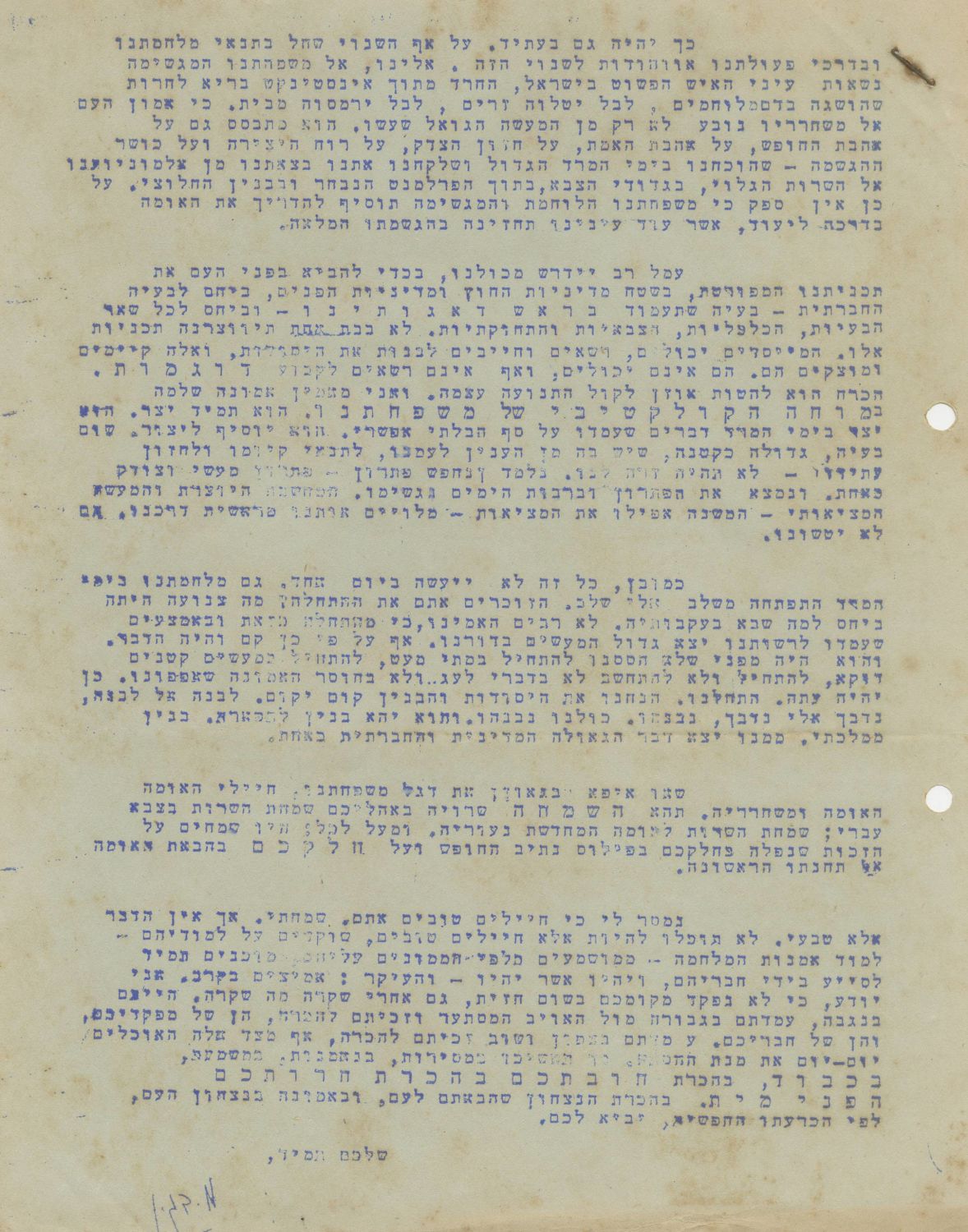
So shall it be in the future. Despite all the attempts to obscure the conditions of our war and the ways of our actions, and despite the warnings of ill tongues, the eyes of the masses in Israel look to us, to our steadfast family. The nation trembles with a healthy instinct for the freedom bought with the blood of fighters, lest foreigners seize it, lest it be trampled from within. For the people’s trust in their liberators stems not only from the redeeming deed itself. It is founded also on the love of freedom, the love of truth, the vision of justice, the spirit of creation, and the morality of fulfillment—which we proved during the days of the Great Revolt and carried with us as we emerged from the underground into open ranks, into the army battalions, within the vanguard of pioneer building. Therefore, there is no doubt that our fighting family will continue to guide the nation on its path toward its destiny, which our eyes shall yet see fully realized.
Much labor will be required of all of us to present our detailed program before the people: in foreign policy, in domestic policy, and regarding the social issue—a problem that will stand at the head of our concerns—as well as regarding all other economic, military, and legislative matters. These plans will not be forged in haste. The foundational members can, may, and must build the program, and these foundations are solid and enduring. They cannot, and must not, skip stages. It is necessary to listen to the voice of the movement itself, and to place full faith in the constructive, collective spirit of our family. Vision creates. In the days of the revolt, vision created realities that bordered on the impossible. It will continue to create. We shall surely build, rising above pettiness, a life meaningful in itself, suited to its conditions and to its future vision—not a mere memorial to past wrath, but a life both practical and just. We will find equality, and in the fullness of time, realize it. Creative purity and realistic action—which reshapes reality itself—have accompanied us from the outset of our journey, and they shall not fail.
Of course, all this will not be done in a single day. Our struggle in the days of the revolt also developed stage by stage. Do you remember the beginning? How modest it was compared to what followed. Not many believed that from such modest means would emerge the greatest deeds of our generation. Yet it came to pass. And it happened because we were not afraid to begin with a few, to start specifically with small steps, and to proceed without regard for mockery or the lack of faith around us. So it shall be now. We shall begin. We shall lay the foundations, and the building will surely rise. Brick by brick, layer upon layer, we shall build it. All of us together. And it shall be a magnificent building, a sovereign building, from which the message of political and social redemption alike shall go forth.
Carry, therefore, with pride the flag of our family, soldiers of the nation and its liberators! May the joy of serving in the Hebrew Army dwell in your tents; the joy of fulfilling the obligations of the mission. Be glad in the privilege that fell to your lot in blazing the trail of freedom, and in your share in bringing the nation its first victory.
I have been told that you are good soldiers. I rejoiced, but it is only natural. You could not be anything but good soldiers, devoted to their studies—learning the art of war—disciplined, always ready to assist their comrades, whoever they may be, and above all: courageous in battle. I know that your place was not absent from any battle line, even after the storm of what happened; as known at Negba, you stood with bravery before the charging enemy and earned the admiration of your commanders and your comrades alike. You brought security, and once again you earned recognition, with honor, in recognition of your duty and your deep inner devotion. Through the seal of victory that you bring to the people, and in faith in the victory that is rising, your full reward will come.
Yours always,
Menachem Begin
מנחם בגין, “מכתב לחיילי האומה ומשחרריה” –
“מכתב לחיילי האומה ומשחרריה” מאת מנחם בגין – חוזר משוכפל. [1948].
המכתב פונה לחיילי האצ”ל, אשר עם תום המנדט ועזיבת הבריטים את ארץ ישראל הצטרפו לשורות צה”ל: “במשך שנים אחרונות שרתתם בצבא היסוד של הצבא העברי, שרתתם באותו צבא השחרור שהרים את נס המרד נגד המשעבד הבריטי ולא הורידוהו אלא עם צאת המשעבד. ואל נא באפכם, אחי, אם לא הכול מודים באותה עובדת היסוד. האמת הגדולה ביותר בהיסטוריה היא, שהאמת חזקה מכזב, שהאמת תמיד מנצחת, אף אם מתמהמה נצחונה […] לא טענו לזכות היחיד על כל מה שהושג בשנות המרד ובעקבותיו. לא, אין אנו טוענים למונופולין. גם גורמים אחרים, רבות זכויותיהם גם במרד, גם בקרב, גם בבנין. אכן, זהו ההבדל בינינו. אנחנו את זכויותיהם של האחרים איננו מכחישים; הם את זכויותינו מנסים להוציא מספר ההיסטוריה של תקופתנו.”
בפסקה האחרונה מתייחס בגין, אם כי לא באופן מפורש, לאחד האירועים הכאובים בימי מלחמת העצמאות – הפגזת האונייה “אלטלנה” בידי כוחות צה”ל: “נמסר לי כי חיילים טובים אתם, שמחתי. אך אין הדבר אלא טבעי. לא תוכלו להיות אלא חיילים טובים […] אני יודע, כי לא נפקד מקומכם בשום חזית, גם אחרי שקרה מה שקרה. הייתם בנגבה, עמדתם בגבורה מול האויב המסתער.”
המכתב התפרסם בעיתון “חרות”, ב-2.9.1948.
Download the complete 1948 newspaper
Herut newspaper Menachem Begin Address to the Soldiers and Liberators of the Nation 1948
All our products are 100% original
World Wide Free Shipping
The Farkash Gallery packs each item professionally. We work with the leading postal companies - UPS, FeDex etc. When
shipping internationally, the buyer is responsible for any customs, duties, or taxes that are set by your destination
country.
Delivery
Estimated Delivery Time is 7-14 days.
Payments
PayPal - Visa, Mastercard, American Express, Discover
Returns
Returns accepted if product not as described. Buyer pays return shipping fee.
100% Money back guarantee (Not including shipping costs)
Guarantee
Money Back Guarantee. Get the item you ordered or get your money back. Buy with confidence.
Related Products
-
Meyer Lansky “Mob’s Accountant”, Original signed letter sent to his Israeli friend,
$0.00 -

2 signed letters by Yitzhak Rabin and Haim Laskov, IDF Chief of Staff
$750.00 Buy Now -
Original Signatures Of Likud Members “Revolutionary Government”, including Menachem Begin, Moshe Dayan, Yosef Burg, Arik Sharon, 1978
$0.00 -
Extremely Rare One-of-a-Kind Original Photography Collection of Jabotinsky in Acre Prison 1920
$2,230.00 Buy Now