
 "Drink Fresh Orange Juice For Strength" Vintage Israeli Poster 1936 Franz Kraus RARE!
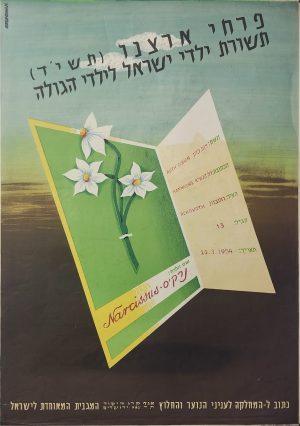 Vintage Poster – Keren Hayesod, “Flowers of Our Land,” israel 1954
 Vintage ISRAELI Poster – "Protected Wild Flowers" 1965
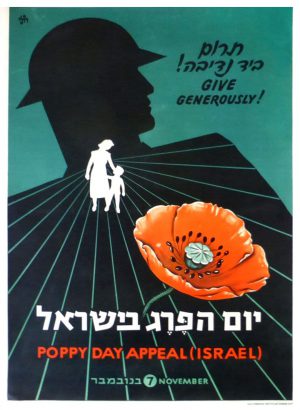 Poppy Day Appeal Vintage Israeli Poster Israel IDF 1950
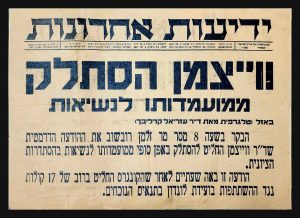 Chaim Weizmann Resigns from the Leadership of the World Zionist Organization Rare Nespaper Special Edition 1946
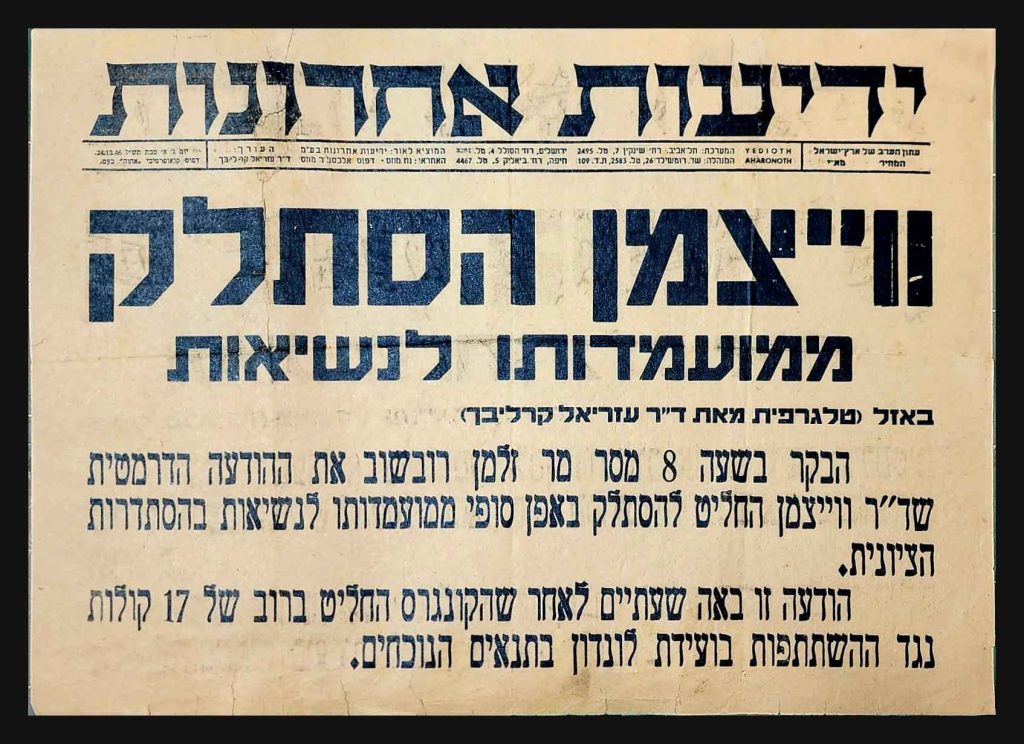
30 Dec A Special Edition Chaim Weizmann Resigns from the Leadership of the World Zionist Organization
A Headline of Uncertainty
December 1946 and the Day Weizmann Stepped Aside

PRESIDENT CHAIM WEIZMANN.
A Special Edition Amid a Shifting Reality
On December 24, 1946, Yedioth Aharonoth appeared in a special edition. Its front page carried a brief yet weighty announcement: Chaim Weizmann had withdrawn his candidacy for the presidency. The wording itself, and the prominence given to the news, reveal how significant the matter was perceived to be by the public at the time.
A Land Without Sovereignty, a Government Without Stability
The context is essential. Palestine was still under British Mandatory rule, but it was a rule visibly eroding—fatigued, hesitant, and increasingly ineffective. Curfews, arrests, underground operations, and restrictions on movement had become part of daily life. The Jewish population lived under constant tension, sensing that a decisive turning point was approaching, though no one could yet foresee its outcome.
The Idea of a Presidency Before the State
Within this unsettled reality, a public discussion was already underway regarding future leadership. The term “presidency” did not yet denote a clearly defined sovereign office, but rather an idea: a figure who might represent the Jewish people once foreign rule came to an end, a symbol of continuity, authority, and international recognition. Chaim Weizmann, President of the World Zionist Organization and a man of considerable international standing, was widely regarded as a natural candidate for such a role.
A Withdrawal That Was Not Merely Personal
Weizmann’s withdrawal from candidacy cannot be understood as a purely personal decision. It reflected deeper tensions and divisions within the Zionist movement itself. There was no broad consensus on the character of future leadership, on the balance between diplomatic leadership abroad and practical leadership in the country, or on the strategy by which independence should be pursued.
The Newspaper as a Forum for Public Debate
Disagreements that had taken place in committees, correspondence, and closed meetings spilled into the pages of the press and became part of public discourse. The newspaper of that day shows a readership following events not as distant observers, but as people whose personal futures were directly bound to the headlines. The withdrawal was read as a sign of instability, but also as an expression of responsibility, caution, and perhaps fatigue on the part of an older leadership facing rapidly changing circumstances.
Looking Back: A Historical Irony
With hindsight, the page carries a clear historical irony. Barely two years after this headline, following the establishment of the State of Israel, Chaim Weizmann would become its first President. What appeared in December 1946 as retreat or relinquishment proved, in retrospect, to be one stage in a long and non-linear process, in which leadership emerged not through clarity and consensus, but through disagreement, delay, and difficult decisions.
Why This Page Still Matters Today
This newspaper is significant precisely because it does not announce victory or resolution. It records a moment of uncertainty, of searching, of a public standing before an unguaranteed future. Reading it today is a reminder that even in other tense times, history rarely advances through grand declarations alone, but often through quiet withdrawals, temporary decisions, and a single headline hinting at a change that has not yet found its name.
Sorry, the comment form is closed at this time.