
 Two Rare Yiddish Zionist Newspapers – Paris, 1947–1948 “To Our Jewish People – Independence Has Been Declared!”
03 May From UN Decision to Independence: Yiddish Voices from Paris, 1947–1948
From Destruction to Rebirth: Two Yiddish Newspapers from Paris Capture the Birth of the State of Israel
In late 1947 and early 1948, post-war Paris became the stage for a unique and deeply charged Jewish reality. The city turned into a major hub for Jewish refugees—Holocaust survivors, displaced persons, and intellectuals—seeking to rebuild their lives after devastation. Many were Yiddish speakers from Eastern and Central Europe: Poland, Lithuania, Hungary, Romania, Germany, Austria, and Czechoslovakia. Some had passed through displaced persons camps in Germany, Austria, and Italy before arriving in Paris, carrying with them not only memories, but an entire cultural world—language, press, and a vibrant intellectual and political discourse. Within this environment, Yiddish journalism flourished once again, serving as a vital voice that connected and guided a scattered community. At the same time, Paris itself was in a period of intense reconstruction and cultural revival, with immigrant neighborhoods—especially in areas like the 10th arrondissement—becoming centers of Jewish life, publishing, and political activity.
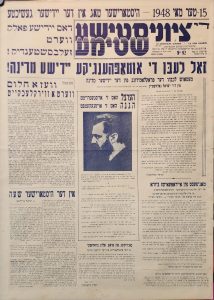
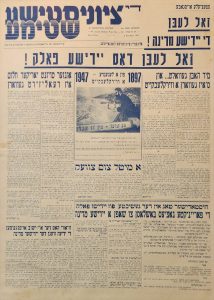
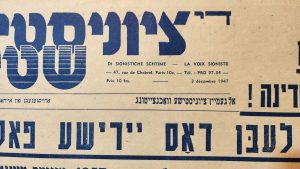
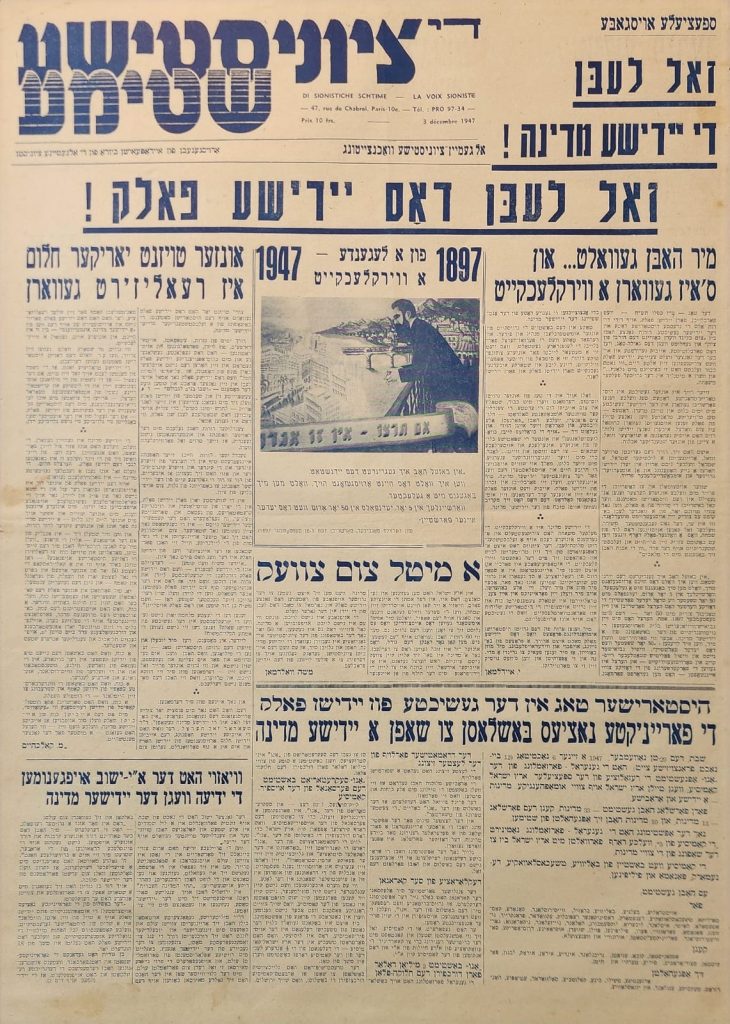
It was in this context that two rare issues of “Di Zionistische Stimme” (La Voix Sioniste) were printed—a Yiddish Zionist newspaper that served as a clear and determined voice for these Jews. Both issues were printed in Paris at 47, rue de Chabrol, located in the 10th arrondissement, an area known at the time for its concentration of Jewish immigrants, printers, and Yiddish cultural institutions. The first issue, dated December 3, 1947, was published just days after the United Nations voted on the Partition Plan for Palestine—a moment when the world formally recognized the possibility of a Jewish state. At first glance, the bold headline stands out, printed in large Yiddish letters:
“אַל אונדזער ייִדישן פֿאָלק!” — “To Our Jewish People!”
This is not merely a newspaper headline, but almost a proclamation—a direct call to a people still recovering from catastrophe, now urged to lift their heads and look forward.
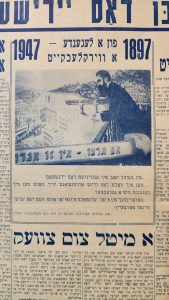
At the center of the page appears a symbolic visual composition: a figure gazing toward a modern city—an image associated with Theodor Herzl and the Zionist vision. Nearby appear the years 1897–1947, forming a clear connection between the First Zionist Congress in Basel and this moment of international recognition. The graphic language is simple yet powerful: sharp lines, stark contrasts, and a sense of forward movement—from vision to reality. Surrounding this central image are articles and subheadings: reports on the UN decision, reactions from Jewish communities worldwide, and political analyses of the implications of partition. Alongside the excitement, one senses complexity—concern for the future, awareness that the struggle is not yet over, but above all, a deep belief that something irreversible has taken place.
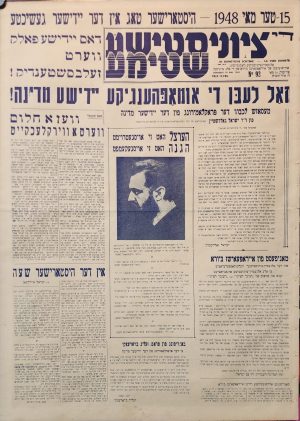
The second issue, dated May 14, 1948, carries an entirely different tone—more dramatic, almost celebratory. Here, the main headline is not just a call but a declaration:
“אַל אונדזער ייִדישן פֿאָלק — די אומאָפּהענגיקייט איז דערקלערט!”
“To Our Jewish People – Independence Has Been Declared!”
The text spreads across the page with urgency, as if striving to reach every reader wherever they may be. Alongside it appears a clear portrait of Theodor Herzl—no longer symbolic, but personal—giving a human face to the idea. Herzl is “present” at the very moment his vision is fulfilled, creating a powerful emotional and historical bridge between past and present.
This issue includes reports from Palestine on the declaration of the state, commentary on the emerging war, and reflections on the immense historical significance of independence. The tone has shifted—less doubt, more certainty. It conveys a moment of culmination, a sharp transition from struggle and uncertainty to a new reality. For its readers—many still in displaced persons camps or just beginning new lives—this was an almost unimaginable moment: only three years after the end of the war, a Jewish state had been established.
Who were these readers? Not only leaders or activists, but ordinary Jews—workers, merchants, intellectuals, survivors—living in Paris and beyond. For them, Yiddish was the language of daily life, and the newspaper was not just a source of information but a cultural and emotional anchor. Zionism, as reflected in these pages, was not merely a political ideology but an existential response—a path toward rebuilding life after destruction, restoring meaning and belonging.
Together, these two issues form a rare and powerful sequence. The first documents the moment when the world said “yes”—the UN decision granting international legitimacy to the idea of a Jewish state. The second captures the moment when the Jewish people themselves declared “we have arrived”—the proclamation of independence and the birth of Israel. Between them lies a brief yet emotionally charged span filled with hope, fear, excitement, and faith.
These are not just newspapers. They are living testimony to a moment when history, ideology, and human experience converged. Through their headlines, imagery, and texts, one can almost hear the voices of those Jews in Paris—people standing between a past of destruction and a future of renewal, aware that they were witnessing one of the most defining moments in Jewish history.
Sorry, the comment form is closed at this time.