

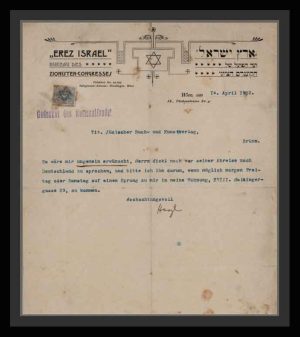
 Zionism – Extremely Rare Official Signed Letter by Theodor Herzl, Vienna 1902, on Bureau des Zionisten-Congresses Letterhead, Altneuland Period, Museum-Quality Judaica Autograph
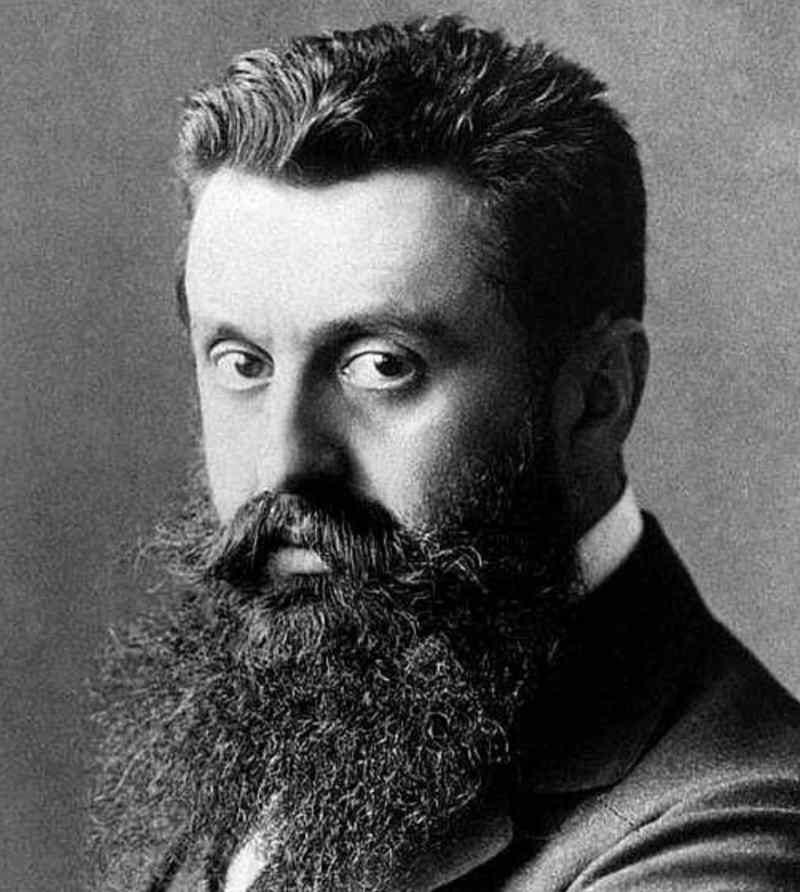
29 Mar Herzl 1902: The Letter That Built Zionism
A rare signed letter from Theodor Herzl capturing the everyday machinery of early Zionism in Vienna, 1902—at the very moment his visionary work Altneuland was shaping the future.
There are documents that remain merely collectible items, and there are those that capture a living moment within a major historical process. The letter newly added to the gallery—a rare official typed letter signed in the hand of Theodor Herzl from 1902—clearly belongs to the latter category. This is not a dramatic political declaration or a theoretical text, but rather a personal, almost routine note that, דווקא through its simplicity, reveals the inner workings of the early Zionist movement..
In 1902, Vienna was one of the most important and influential cities in the world. Under the long reign of Emperor Franz Joseph I, the city stood at the height of its cultural and intellectual flourishing. Its cafés served as meeting places for writers, journalists, and thinkers, and the atmosphere was one of intense creativity alongside growing political and social tensions. For European Jewry, Vienna represented both opportunity and uncertainty, as antisemitism was simultaneously gaining ground. Within this environment, Herzl operated not only as a visionary, but as a man of action.
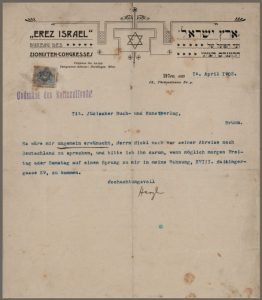
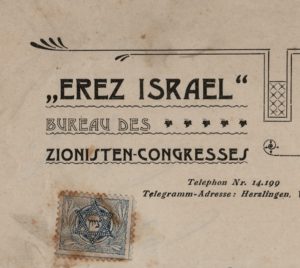
The letter is written on official stationery of the Bureau des Zionisten-Congresses—the central administrative body of the Zionist movement. Alongside it operated the Zionist Executive Committee, the movement’s working leadership between congresses, responsible for implementing decisions, managing ongoing activity, coordinating international relations, and raising funds. This was, in effect, a functioning governing mechanism that transformed Zionism from an idea into a practical movement. The letterhead itself tells a story: it includes modern communication details for the time, such as a telephone number and the telegraph address “Herzlorgan,” as well as the slogan “Gedenket des Nationalfonds!”—a direct appeal to support the national fund.
That “National Fund” refers to the Jewish National Fund, established in 1901 and one of the most important institutions of practical Zionism. Its purpose was to raise funds from Jews around the world to acquire land in Palestine, thereby laying a tangible foundation for future Jewish settlement. The slogan printed on the letter is not merely decorative—it reflects how every document, every letter, and every communication also served as a tool for advocacy and fundraising.
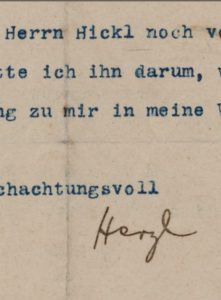
At first glance, the content of the letter is simple: Herzl asks to meet a man named Hickl before his departure to Germany and invites him to his Vienna residence. There is no ideological discussion or political program here, only a request for a meeting. Yet precisely in this simplicity lies its importance—the Zionist movement was built not only on grand ideas, but on a dense network of personal relationships, meetings, collaborations, and constant human interaction. Addressed to a Jewish publishing house in Brünn, the letter connects political leadership with the world of culture and print—two essential pillars in the dissemination of Zionist ideas.
The year 1902 is no coincidence. In that same year, Herzl published his utopian novel Altneuland, in which he envisioned a modern Jewish society in the Land of Israel. While his earlier work, “The Jewish State,” presented a political framework, “Altneuland” offered a vivid image of the future—an advanced, equitable, and technologically progressive society. The letter before us was written at precisely this moment, when Herzl was operating on two levels simultaneously: articulating a vision of the future while actively working to build it.
Another remarkable feature of the document is the early Zionist label affixed to it, bearing a Star of David and the word “Zion.” This is not an official postal stamp, but rather an early propaganda and fundraising label directly connected to the activities of the Jewish National Fund, illustrating how visual symbols were integrated into the broader effort of mobilization and public awareness.
The uniqueness of this letter lies in the combination of all its elements: Herzl’s original signature, official Zionist Congress stationery, the connection to the Zionist Executive’s activity, the link to the Jewish National Fund, and its dating to the very year of the publication of “Altneuland.” It is a document that connects a person, an idea, and an emerging system, offering a rare glimpse into a moment when history was still being written. For collectors and scholars alike, this is an item of exceptional significance—not only because of its rarity, but because of the story it carries: the story of the birth of a movement that would ultimately change the course of modern history.
Sorry, the comment form is closed at this time.