

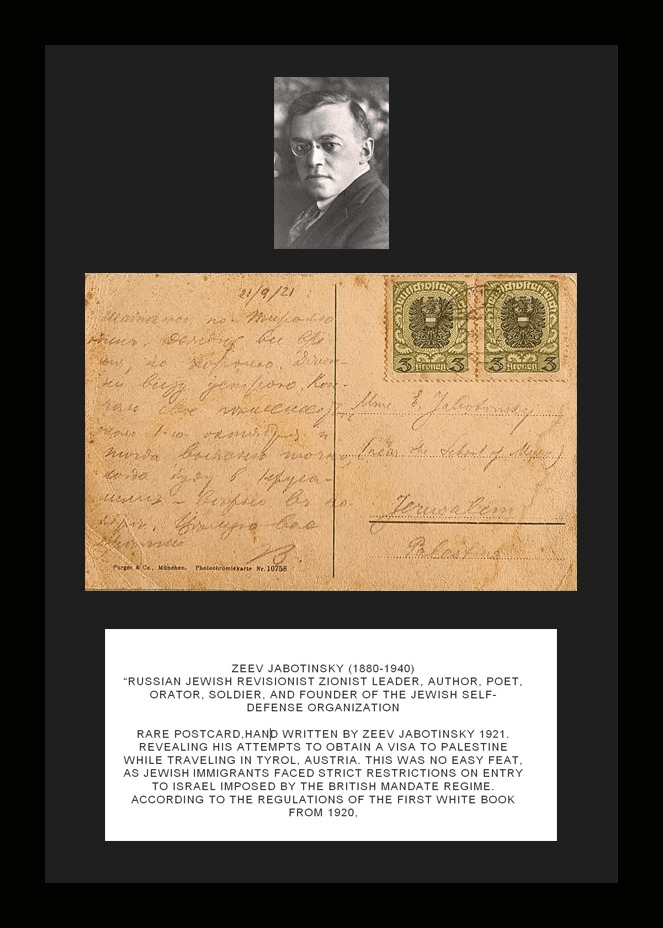
01 Oct Jabotinsky Conquers the Zionist Congress – But is Blocked on His Way to the Promised Land! 1921
Historical Revelation: The Postcard from Tyrol, the Zionist Congress, and the Slamming Doors of the Land of Israel
In September 1921, far from Jerusalem, one of the most prominent and fiery leaders of the Zionist movement leaned over a table in the Tyrol region of Austria and wrote a postcard. This rare historical item, dated 21/9/21 at the top, provides a fascinating glimpse into a personal and political struggle waged by Ze’ev Jabotinsky, reflecting the complex reality of the era.
The Man Behind the Words: Leadership Tested Ze’ev Jabotinsky (1880-1940) was a Russian-Jewish Revisionist Zionist leader, author, poet, orator, military man, and founder of the Jewish self-defense organization. Beyond being a central thinker gifted with rare rhetorical and literary talent, Jabotinsky was a man of action. Just a year prior to writing this postcard, in the spring of 1920, he headed the Jewish defenders in Jerusalem during the 1920 Palestine riots (Nebi Musa riots). Following his activities, he was arrested by the British authorities and imprisoned in Acre Prison. His release, which came after heavy public pressure, turned him into a national hero and a key figure in Zionist politics.
The Fascinating Connection to the 12th Zionist Congress The date on the postcard—September 21, 1921—is no coincidence; it ties into a dramatic event in the Zionist world that occurred that very month: the 12th Zionist Congress.
Between September 1 and 14, 1921, the first Zionist Congress following World War I and the Balfour Declaration convened in Carlsbad (now in the Czech Republic). This Congress held immense historical significance, and Jabotinsky took an active and central role in it. During the Congress, he was elected for the first time as a member of the Zionist Executive. Upon the conclusion of the Congress in mid-September, he continued his travels across Central Europe, arriving in the Tyrol region of Austria, from where this postcard was sent.
Austria and the Zionist Movement in 1921 Jabotinsky’s presence in Austria blended perfectly with the spirit of the time. Following the collapse of the Austro-Hungarian Empire at the end of World War I, Vienna became one of the most important and vibrant hubs of Zionism in Europe. Among other things, it served as a critical transit station for tens of thousands of Jewish refugees from Eastern Europe fleeing the horrors of pogroms and the Russian Civil War.
In the Austria of those days, an active Zionist leadership operated, a Jewish press flourished, and numerous Zionist student associations were established. Jabotinsky worked vigorously within the German- and Russian-speaking spheres, aiming to raise funds for “Keren Hayesod” (the Foundation Fund), organize the masses, warn of the dangers lurking for European Jewry, and demand the full opening of the gates to the Land of Israel.
The Bureaucratic Struggle Over the Gates of the Land The written content reveals how, during this trip, Jabotinsky was attempting to secure an entry visa to Palestine while traveling in Tyrol, Austria. This task was not at all easy, as Jewish immigrants at the time faced severe restrictions on entering the land, imposed by the British Mandate authorities. According to the documentation attached to the postcard, this rigid policy was based on the regulations of the “First White Paper of 1920,” which began to curtail the right of Jews to immigrate freely. (The White Paper was an official policy document of the British government. In Mandatory Palestine, the “White Papers” were intended to define and clarify the British Mandate’s policy, and were often used as a tool for gradual retreat from the promises made to the Zionist movement in the Balfour Declaration. These documents typically included regulations that significantly restricted Jewish immigration quotas and their ability to purchase land, aiming to curb Jewish immigration and ease tensions with the Arab population).
This rare postcard serves as a living testament to a jarring and moving paradox: on the one hand, Jabotinsky was a senior national Zionist leader who had just achieved a tremendous political feat and been elected to the leadership of the global movement; on the other hand, he found himself struggling in a humiliating bureaucratic maze, standing before locked gates, just so he could return home to his family in Jerusalem.
Transcription and Deciphering of the Postcard The postcard is divided into two parts, as was customary in those days:
Right side – The Address (in Latin letters):
-
Mme E. Jabotinsky (Mrs. E. Jabotinsky – his wife Yoana, nicknamed Anya)
-
(Care of The School of…) (A faded line likely containing the address of an institution or secondary recipient through which the mail was forwarded)
-
Jerusalem
-
Palestine
At the top, two Austrian postage stamps (Deutschösterreich) are affixed, with a value of 3 kronen each.
Left side – The Content (in Russian):
-
Date: 21/9/21
-
The original text in Russian: “Шатаюсь по Тиролю, ожидая все визы, но напрасно. Сегодня еду устроить как-нибудь свое жительство около 1-го октября и тогда выясню точно когда буду в Иерусалиме… Целую вас. В.”
-
English Translation: “I am wandering around Tyrol, waiting for all the visas, but in vain. Today I am traveling to somehow arrange my residency around October 1st, and then I will find out exactly when I will be in Jerusalem… Kisses to you. V.” (The signature “V” stands for the first letter of his Russian name, Vladimir).
Sorry, the comment form is closed at this time.