

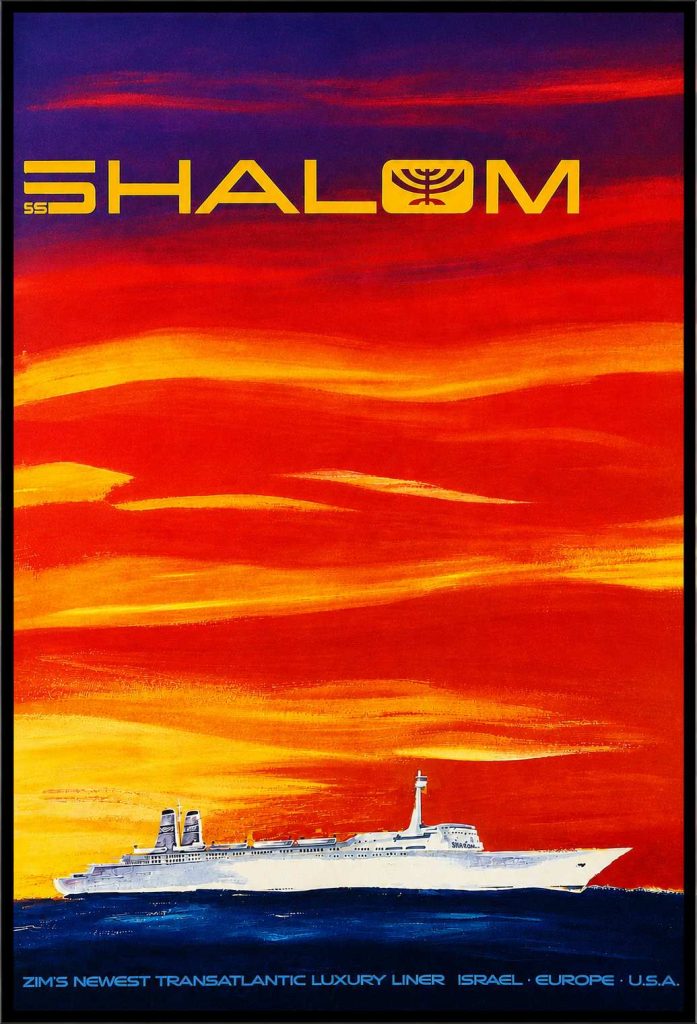
14 May Shalom: The Floating Dream That Became Israel’s Titanic
My father was an antique dealer in Haifa, and from a very young age I was always by his side. in 1967 When I was about five years old, he told me one day, “Come, we’re going to the port of Haifa to see merchandise from large ships.”
We drove to Port of Haifa, and I still remember the shock of seeing those enormous ships. When you are a small child, everything feels gigantic. The cranes, the docks, the smell of the sea and steel, and the massive ship standing in front of us like a floating city. Only later did I understand that this was not just another ship — it was the famous liner Shalom. It turned out that the ship had already become a financial disaster, had been sold, and much of its contents were being liquidated. We entered the ship, and I was overwhelmed. It was luxurious in a way that is difficult to explain today. Giant murals, modernist lounges, thick carpets, brass lamps, magnificent dining ware — and on every plate, cup, and piece of silverware appeared the ship’s logo: “Shalom.” Even the napkins and ashtrays carried the emblem.
I asked my father, “Why does anyone need all this equipment?”
And he answered, “Aharon, everything I buy now will one day be worth a lot of money.”
There were many dealers there. Everyone was trying to buy whatever they could — silverware, furniture, paintings, lamps, kitchen equipment. In the end, we bought all the dining ware, several paintings, and a few pieces of furniture. We left the port and drove to the flea market. We brought a truck, and I remember myself loading box after box, wrapping plates one by one in old newspapers. Afterwards, we drove to my father’s warehouse and unloaded everything. The next day, a hotel owner from Haifa arrived, and my father sold him almost everything. I asked him, “But you said that one day it would all be worth a lot of money — so why are you selling it?”
He smiled and said, “We need money now, not in the future.”
Years later, almost every original item from the Shalom — a plate, menu, glass, ashtray, piece of silverware, or sign — became a rare and highly valuable collectible. But at the time, as a little boy, I had no idea that I was walking through one of the greatest and most ambitious stories of young Israel. The Shalom was much more than a ship. She was an Israeli dream.
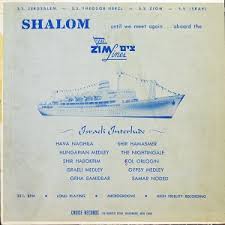
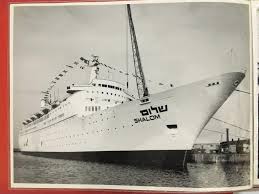

In the late 1950s and early 1960s, ZIM Integrated Shipping Services, then still a government-owned company, dreamed of opening a glamorous new era of transatlantic passenger travel. Israel was a young country, still emerging from austerity and economic hardship, yet determined to present itself as modern, sophisticated, and internationally connected. The vision behind the Shalom was enormous. ZIM wanted a luxury liner that would attract wealthy tourists from Europe and America while serving as a floating showcase of Israeli achievement and national pride. The model chosen was the great French liner France — at the time one of the most luxurious ships in the world — and the Shalom was designed almost as a smaller Israeli version of it. Ironically, while this dream was taking shape, the transatlantic passenger ship industry was already beginning to collapse. In 1959, for the first time in history, more people crossed the Atlantic by airplane than by ship. But the planners ignored the warning signs.
The ship itself became a national project. A special committee headed by Israeli President Yitzhak Ben-Zvi was formed to choose her name. The poet Avraham Shlonsky proposed the name “Shalom,” intended to represent the beautiful and enlightened face of Israel to the world. Her launch ceremonies became national celebrations. Public officials and members of parliament attended, and the famous Israeli trio Geshar HaYarkon performed the specially written song “Shalom on the Waves,” with lyrics by Haim Hefer and music by Naomi Shemer. The ship was built at the Chantiers de l’Atlantique shipyards in Saint-Nazaire and officially launched in the early 1960s. She displaced about 25,000 tons, carried more than 1,100 passengers and 450 crew members, and featured ten decks filled with luxury accommodations, grand dining halls, theaters, libraries, swimming pools, promenades, sports facilities, children’s playrooms, and even a synagogue. Her interiors were designed as a floating museum of modern art. Israeli and international artists decorated the ship with paintings, sculptures, glass works, textiles, and custom furniture. Artists such as Dani Karavan and Yaacov Agam contributed works, while legendary designer Dora Gad helped create the modernist interiors. She famously declared that “good design has no financial limits here.” The costs became staggering. By the time construction was completed, the Shalom had cost roughly 20 million dollars — an enormous sum for Israel at the beginning of the 1960s. What was meant to symbolize Israeli ambition quickly began to resemble a massive national gamble. When she entered service in 1964, she instantly became Israel’s equivalent of the RMS Titanic — not because of disaster, but because of symbolism. Like the Titanic in its time, the Shalom represented national pride, technological confidence, luxury, and the belief that a nation could announce itself to the world through a magnificent ship.
And like the Titanic, she was also born at exactly the wrong historical moment. The Titanic appeared just before the old European world collapsed into war. The Shalom appeared just as the golden age of ocean liners was dying under the rise of jet aviation. The Shalom mainly sailed between Port of Haifa and New York City, with stops in Marseille, Genoa, and Naples. She also operated Caribbean cruises and pleasure voyages. But very quickly it became clear that ZIM could not fill her cabins consistently enough to make her profitable. The ship soon became controversial in Israel itself. One of the first political scandals erupted because two kitchens had been built onboard — one kosher and one non-kosher. Religious political parties protested that a “national” Israeli ship should not serve non-kosher food and even threatened to leave the government coalition. Eventually, the non-kosher kitchen was temporarily closed. Then came disaster. In 1964, shortly after beginning Caribbean service, the Shalom collided in heavy fog near the coast of Brazil with the Norwegian tanker Stolt Dagali, cutting the tanker in half. Nineteen crewmen were killed. Investigations blamed both ships, but the tragedy severely damaged the reputation of the Shalom and cost ZIM enormous sums in lawsuits, repairs, and lost prestige. Rumors also spread in Israel about extravagant waste onboard — stories that silverware was thrown into the sea rather than washed became symbolic of what critics viewed as excess and mismanagement. Meanwhile, the airline industry was transforming the world. Flights became faster, cheaper, and more common. A transatlantic crossing that once took a week at sea could now be completed in hours. Passenger liners around the world were collapsing economically, and the Shalom became a giant “white elephant” — beautiful, impressive, but financially unsustainable.
Eventually, ZIM had no choice but to withdraw the ship from service and return her to Haifa. In 1967, she was sold to a German company — a move that caused another political uproar in Israel. For many Israelis, especially Holocaust survivors and nationalist circles, selling such a symbolic national ship specifically to Germans felt deeply painful and humiliating. The name “Shalom” disappeared, and the ship became the Hanseatic. But her story still continued. Over the following decades she passed through several companies and identities, sailing under different names and flags around the world. At one stage she even served as a floating hotel in Panama.
Finally, in 2001, after years of neglect, she was sold for scrap and began her final journey while being towed toward India for dismantling. But near the Cape of Good Hope, on July 25, 2001, water penetrated the aging hull due to years of poor maintenance, and the ship sank into the Atlantic Ocean.
And that was the end of the Shalom.
Not in a dramatic explosion like the Titanic. Not in a legendary catastrophe. But slowly, quietly, like the fading dream of another era disappearing beneath the water with time.

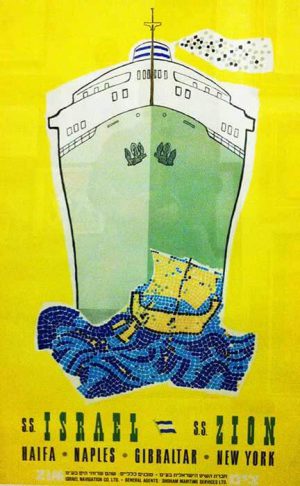
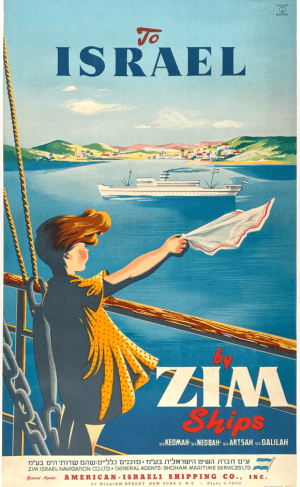
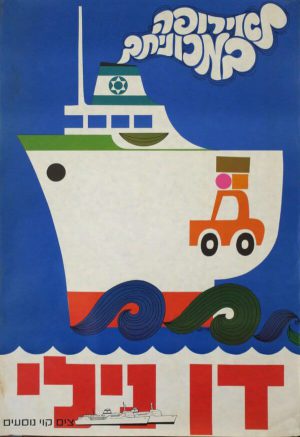
ZIM Company Posters From Our Collection





Sorry, the comment form is closed at this time.