

 Vintage Israeli Poster - Kesem Washing Powder by Franz Kraus Palestine Eretz Israel FRANZ KRAUS 1930s
 038th Israeli Independence Day Vintage Poster israel 1986
Shop
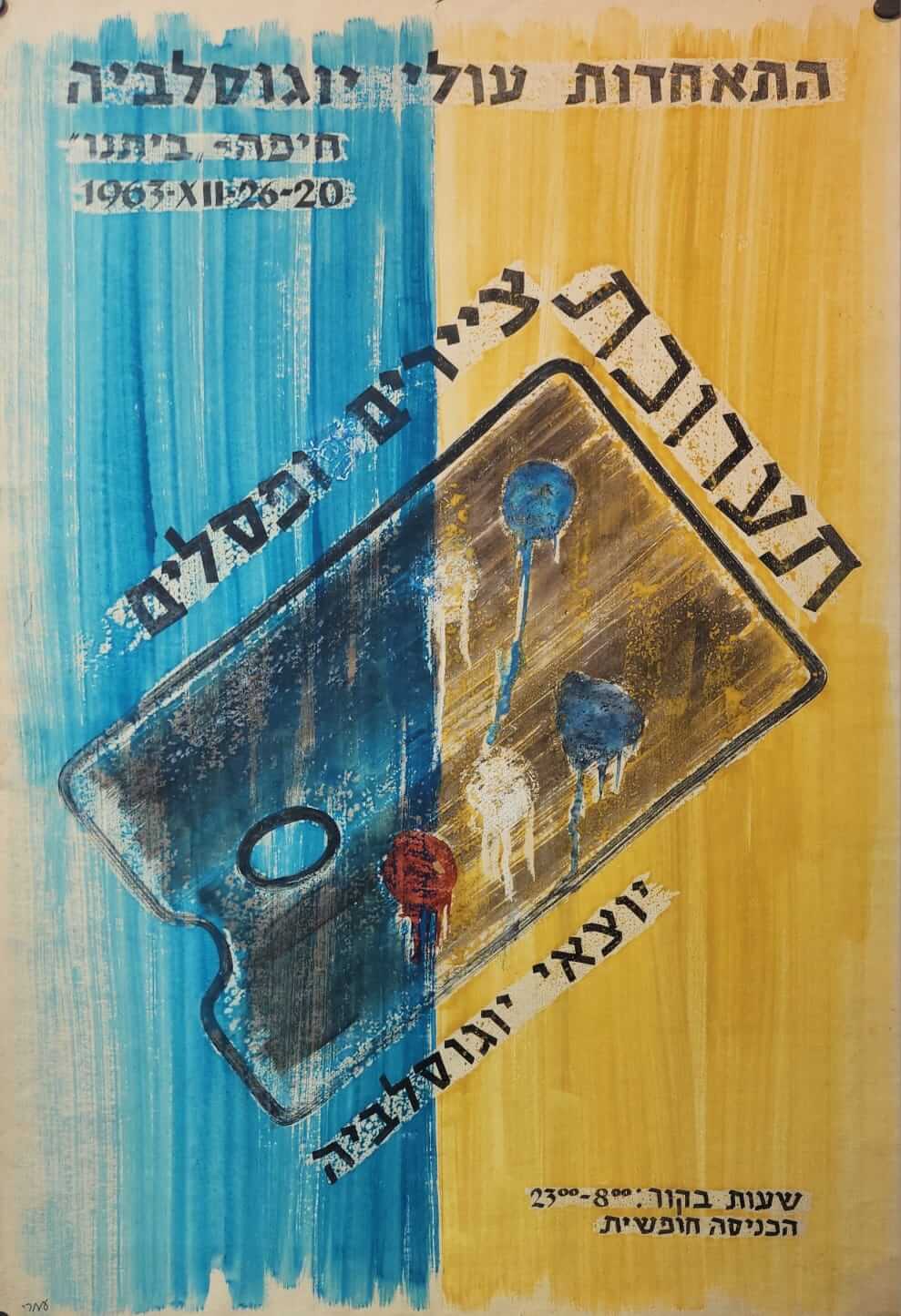
Union of Yugoslav Immigrants Exhibition of Painters and Sculptors Vintage Poster, 1963
$900.00
1 in stock
| Artist / Creator | |
|---|---|
| Year | |
| Condition | |
| Size | |
| A | |
| Technique |
Description
Union of Yugoslav Immigrants – Exhibition of Painters and Sculptors – Vintage Poster, 1963
The Jewish community of Yugoslavia was a significant and diverse one, composed of many individual communities spread across the Balkan regions that made up Yugoslavia.
It was one of the most varied Jewish communities in the Balkans, as it included Jews from Slovenia, Serbia and Montenegro, Bosnia and Herzegovina, Croatia, and Macedonia. Each of these regions was at various times under the control of different empires and powers, resulting in highly diverse communities. Together, they represented a broad spectrum of both Ashkenazi and Sephardic Jews.
Jews first arrived in the territories of Yugoslavia during the Roman Empire. More substantial waves of immigration occurred at the end of the 15th century, following the expulsion from Spain. Many Spanish Jews initially settled in Salonika and Constantinople (Istanbul), but when they struggled to make a living there, some migrated to Belgrade (Serbia), Sarajevo (Bosnia), and Skopje and Bitola (Macedonia).
After World War I, the various Balkan states were unified, leading to the unification of their Jewish communities as well. However, during World War II, Yugoslavia was partitioned, and so were its Jewish populations in Serbia, Croatia, and elsewhere. Of the approximately 80,000 Jews who lived in the region before the war, only a few thousand survived.
After World War II, Yugoslavia remained a single, unified state until the Yugoslav Wars of the 1990s, which led to its breakup into several independent countries.
Aliyah to Israel (Immigration):
Following WWII and the Holocaust, many Yugoslav Jews—especially survivors—emigrated to the newly founded State of Israel. The rise of anti-Semitic regimes, the destruction of Jewish communities during the Holocaust, and the appeal of Zionism all contributed to a wave of immigration. This group of immigrants established various community organizations in Israel, including the Union of Yugoslav Immigrants, which supported cultural preservation and integration. Cultural events such as exhibitions of painters and sculptors, like the one on this 1963 poster, were part of their effort to maintain their heritage while contributing to Israeli cultural life.
Hand-painted poster, gouache paper
All our products are 100% original
World Wide Free Shipping
The Farkash Gallery packs each item professionally. We work with the leading postal companies - UPS, FeDex etc. When
shipping internationally, the buyer is responsible for any customs, duties, or taxes that are set by your destination
country.
Delivery
Estimated Delivery Time is 7-14 days.
Payments
PayPal - Visa, Mastercard, American Express, Discover
Returns
Returns accepted if product not as described. Buyer pays return shipping fee.
100% Money back guarantee (Not including shipping costs)
Guarantee
Money Back Guarantee. Get the item you ordered or get your money back. Buy with confidence.
Related Products
-

040th Israeli Independence Day Vintage Israeli Poster israel 1988
$2,800.00 Buy Now -
016th Israeli Independence Day Vintage poster 1964
-

064th Israeli Independence Day Vintage Poster israel 2012
$1,200.00 Buy Now -
049th Israeli Independence Day Vintage Israeli Poster 1997 The Year of Zionism
$1,200.00 Buy Now
