

31 May The Dreyfus Affair – One of the Greatest Symbols of Modern Antisemitism
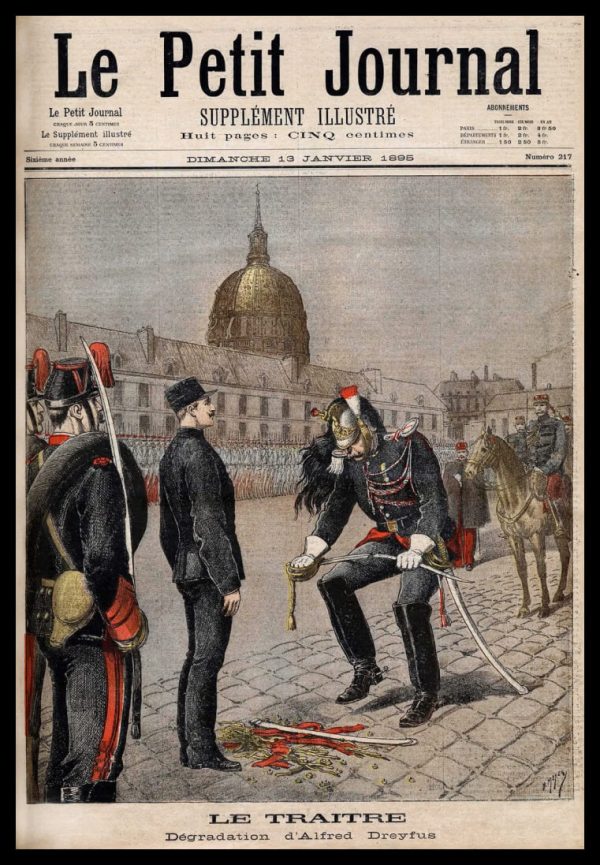
On January 13, 1895, the French newspaper Le Petit Journal published one of the most famous front pages in newspaper history. It depicted a French army officer standing at attention while his military insignia were torn from his uniform and his sword was broken before a crowd of thousands. The headline beneath the image was unequivocal: “The Traitor – The Degradation of Alfred Dreyfus.”
At that moment, most of the French public believed they were witnessing the punishment of a dangerous traitor who had sold military secrets to Germany. Few imagined that they were actually witnessing the public humiliation of an innocent man—one who would become the victim of one of the most notorious miscarriages of justice in modern history. The Dreyfus Affair would come to symbolize antisemitism, judicial corruption, and the moral failure of an entire society.
France at the End of the Nineteenth Century
Although France was the first European country to grant full civil rights to Jews following the French Revolution, antisemitism had by no means disappeared. On the contrary, by the late nineteenth century it was experiencing a resurgence.
Economic difficulties, the humiliation of France’s defeat in the Franco-Prussian War of 1870–71, and the rise of aggressive nationalism created an atmosphere in which Jews were increasingly portrayed as outsiders, disloyal citizens, and enemies within. Antisemitic newspapers sold hundreds of thousands of copies and regularly accused Jews of controlling finance, politics, and the press.
Within this climate stood Captain Alfred Dreyfus, a Jewish officer from a prosperous family in Alsace. Intelligent, ambitious, and one of the few Jews to rise through the ranks of the French Army, he became an ideal target for those seeking a scapegoat.
The Accusation
In September 1894, French intelligence obtained a torn memorandum from the German Embassy in Paris. The document, later known as the bordereau, listed several confidential military documents that had allegedly been offered to the Germans.
Investigators quickly searched for a suspect and focused their attention on Dreyfus. The evidence against him was weak from the beginning. Handwriting experts disagreed over whether he had written the memorandum, no convincing motive was established, and no direct proof linked him to espionage. Nevertheless, many officers and politicians were already convinced of his guilt. To them, the fact that he was Jewish seemed sufficient reason for suspicion. Dreyfus was arrested in October 1894 and brought before a military court.
The Public Degradation Ceremony
A Trial Without Justice
The trial was conducted behind closed doors. Even more troubling, prosecutors secretly provided judges with documents that were never shown to the defense. Dreyfus and his lawyers were denied access to the very evidence being used against him. The proceedings violated basic principles of justice.
Despite the lack of credible evidence, the court unanimously convicted Dreyfus of treason. Years later it would emerge that some of the secret documents had no connection whatsoever to the case, while others had been fabricated to ensure a guilty verdict.
The Public Degradation Ceremony
On January 5, 1895, the French Army staged a public degradation ceremony at the courtyard of the École Militaire in Paris. Thousands gathered to watch.
Soldiers surrounded the courtyard as a senior officer approached Dreyfus and stripped him of his rank. His insignia were torn from his uniform one by one. Finally, his sword was taken and broken in half before the crowd.
The spectators erupted:
“Death to the Jews!”
“Traitor!”
“To the gallows!”
Dreyfus stood firm and repeatedly shouted:
“I am innocent!”
“Long live France!”
His voice was drowned out by the fury of the crowd.
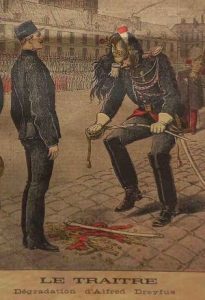
The image reproduced on the front page of Le Petit Journal captures this exact moment—a moment when an entire nation believed in the guilt of a man who had committed no crime.
Devil’s Island – Exile at the Edge of the World
Following his conviction, Dreyfus was deported to Devil’s Island, a remote penal colony off the coast of French Guiana in South America.
The island was notorious for its harsh conditions. Dreyfus was held in near-total isolation. He was forbidden from speaking to other prisoners and was at times shackled to his bed at night. He endured tropical heat, disease, insects, loneliness, and psychological torment. Meanwhile, his wife Lucie and the rest of his family remained in France, tirelessly campaigning to prove his innocence. For years Dreyfus had no idea whether he would ever return home.
The Discovery of the Real Culprit
In 1896, Lieutenant Colonel Georges Picquart, head of French military intelligence, discovered evidence pointing to another officer, Ferdinand Walsin Esterhazy, as the true spy. Picquart was not a political activist, nor was he a particular supporter of Dreyfus. He simply followed the evidence. When he reported his findings, he expected the military to reopen the case. Instead, he was removed from his position and transferred. The Army leadership preferred to protect its reputation rather than admit that it had condemned an innocent man.
J'accuse Newspaper
“J’Accuse…!”
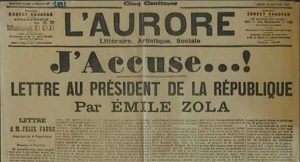
In January 1898, the celebrated French writer Émile Zola entered the struggle. He published his famous open letter “J’Accuse…!” (“I Accuse…!”) on the front page of the newspaper L’Aurore. Zola directly accused military leaders, judges, and government officials of fabricating evidence, concealing the truth, and condemning an innocent man because he was Jewish. The article created a political earthquake. France split into two camps: the Dreyfusards, who demanded justice and a retrial, and the anti-Dreyfusards, who viewed criticism of the Army as an attack on the nation itself. Families, political parties, newspapers, and even the Catholic Church became divided by the controversy.
Dreyfus Is Finally Vindicated
After years of public pressure, a retrial was ordered. Yet astonishingly, the military court again found Dreyfus guilty in 1899, although under mitigating circumstances. The verdict sparked international outrage. Eventually, the French government granted him a pardon. Only in 1906—twelve years after his arrest—was the conviction formally overturned. Dreyfus was completely exonerated, reinstated in the French Army, and awarded the Legion of Honour.
The man once branded as France’s greatest traitor was finally recognized as the victim of prejudice, institutional corruption, and antisemitic hatred.
The Impact on Zionism
Among the journalists covering the affair in Paris was a young Jewish correspondent named Theodor Herzl. Herzl witnessed firsthand how crowds in one of Europe’s most enlightened and democratic societies could chant “Death to the Jews” simply because a Jewish officer had been accused of a crime.
Although the Dreyfus Affair was not the sole cause of modern Zionism, it reinforced Herzl’s belief that Jews could never rely entirely on the goodwill of others for their security. Within a few years, he would lead the movement that culminated in the First Zionist Congress and the emergence of modern political Zionism.
Legacy
Today, the Dreyfus Affair is remembered as one of the most significant examples of instituAtional antisemitism in modern history. It demonstrated how prejudice, political interests, sensationalist journalism, and national hysteria could overwhelm truth and justice. The issue of Le Petit Journal shown here is far more than a rare newspaper. It is a powerful historical witness to a moment when falsehood triumphed over fact and when public opinion condemned an innocent man. More than a century later, the Dreyfus Affair remains a warning about the dangers of hatred, the fragility of justice, and the importance of defending truth even when the crowd demands otherwise.
Sorry, the comment form is closed at this time.