

 Vintage JNF Poster Jewish National Fund Israel 1958 Franz Kraus
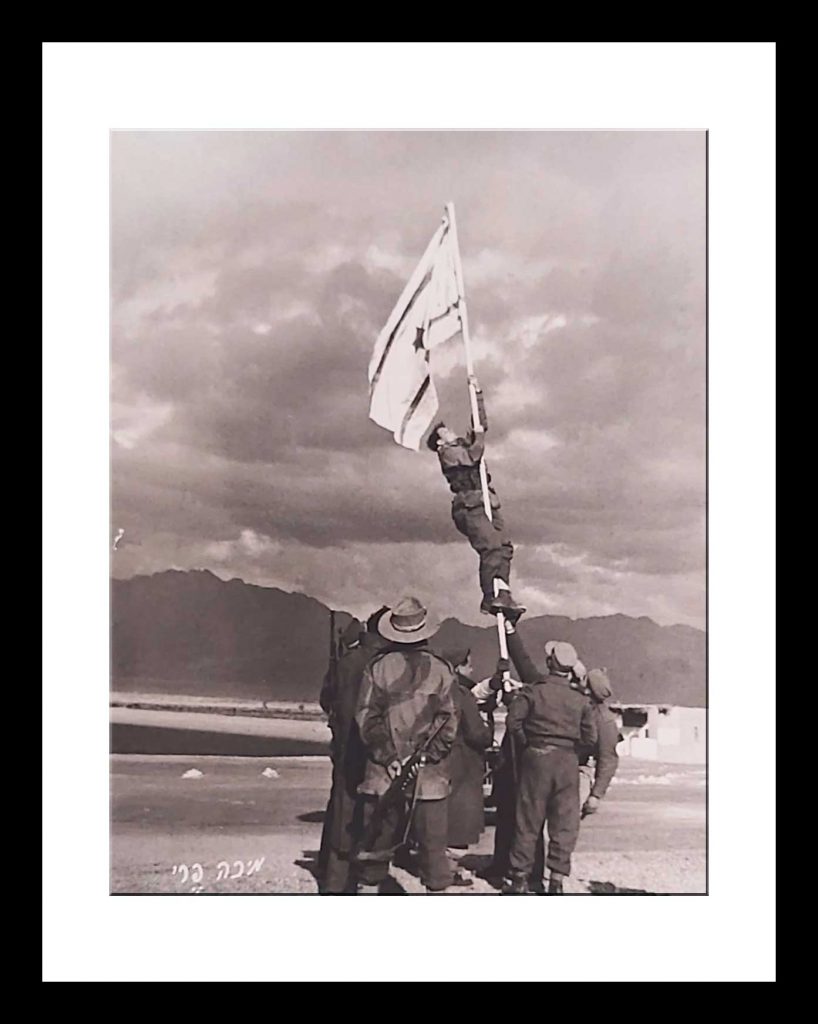
25 Apr “The Iconic Ink Flag” Photograph of 1949 – The Moment Israel’s War of Independence Came to an End
On March 10, 1949, in the late afternoon, Avraham Adan (“Bren”), a young fighter in the 7th Battalion of the Negev Brigade, climbed a makeshift pole and raised a flag that had been created only moments earlier from a simple white bedsheet. This was the “Ink Flag” – a symbol born out of improvisation, yet one that became one of the most powerful images marking the end of Israel War of Independence. The moment itself was not ceremonial or staged; there were no speeches, no music, no audience – only a handful of soldiers in the quiet desert, aware that they were standing at a turning point in history.
The War of Independence – A Struggle for Survival
To understand the power of this moment, one must return to its context. The War of Independence was not merely a conflict over borders, but a struggle for the very existence of a state. Following the 1947 UN Partition Plan, violence erupted between Jewish and Arab communities. After Israel declared independence in May 1948, neighboring Arab armies invaded, turning the conflict into a full-scale regional war. The Negev was one of the most challenging fronts: vast, sparsely populated, and difficult to supply. Egyptian forces advanced northward, isolating Jewish settlements. Fighting there required not only courage, but ingenuity, mobility, and the ability to operate under extreme conditions. By early 1949, after a series of successful Israeli operations, it became clear that the war was nearing its conclusion. Yet the final borders were still undetermined – especially in the far south.
Umm Rashrash – Before It Became Eilat
The objective of the operation was Umm Rashrash, a small, remote police outpost on the shores of the Red Sea. It was not a town in any meaningful sense – no streets, no infrastructure, only a modest building surrounded by harsh desert. Yet this isolated point held immense strategic value. Control over it meant access to the Red Sea – a vital maritime gateway for trade and international connection. Today, this location is known as Eilat, a thriving resort city and port. In 1949, it was a quiet, almost forgotten place upon which a major political reality would be decided.
Operation Uvda – A Race to Define Reality
As part of Operation Uvda, Israeli forces moved south with a clear mission: to reach Umm Rashrash first and establish control. The uniqueness of the operation lay in the fact that it was not designed as a battle, but as a strategic maneuver. The military phase of the war was largely over; what remained was the political act of presence. Two main forces advanced simultaneously: Negev Brigade – moving through the heart of the desert, across difficult and unmarked terrain Golani Brigade – advancing through the Arava Valley from the east Thus, a quiet yet dramatic race emerged. Not gunfire, but navigation, endurance, and determination would decide the outcome.
The Journey – A Test of Endurance
The march south was anything but simple. Soldiers traveled by jeep and on foot through terrain that was often barely mapped. There were moments of disorientation, severe shortages of water, and mechanical breakdowns.
The desert allowed no mistakes. Every delay could prove critical. The challenge was not only physical but psychological: these soldiers knew they were in the final phase of the war – yet they still had to push forward, knowing that this last effort could determine the future map of Israel.
The Negev Brigade – The Spirit of the Palmach
The force that ultimately arrived first and raised the flag was the 7th Battalion of the Negev Brigade. This Palmach unit had fought throughout the war under some of its harshest conditions. They faced Egyptian forces, shortages of equipment, and the constant difficulty of operating in open desert terrain. It was precisely this experience – fighting under pressure and scarcity – that enabled them to complete the final mission. They were not just soldiers, but pioneers driven by a deep sense of purpose.
The Ink Flag – A Symbol of a Generation
When the soldiers arrived, they discovered they had no official flag. Instead of waiting, they created one: a white sheet, ink, and a simple drawing of the Israeli flag. This act captures the essence of the era – not perfection, but creation out of necessity. A flag not prepared in advance, but born in the moment – and therefore perhaps more authentic than any official version.
Micha Perry – The Eye That Captured History
The moment was documented by Micha Perry, a soldier who was part of the force. He was not there as an outside observer, but as a participant. His photograph was not staged: a man climbing, soldiers looking upward, the vast desert beyond. These elements combined into a natural yet powerful composition. The image became one of the most iconic in Israeli history – not just recording an event, but shaping collective memory.
A Comparison to Iwo Jima – Two Flags, Two Meanings
The photograph is often compared to the famous image from the Battle of Iwo Jima, taken by Joe Rosenthal. The visual similarity is clear – soldiers raising a flag, a shared upward motion. Yet the meaning is fundamentally different: At Iwo Jima – a symbol of victory in a brutal battle At Umm Rashrash – a symbol of presence, of defining reality without combat It is the difference between a flag of triumph and a flag of creation.
The End of War – The Beginning of a State
The raising of the Ink Flag represents the transition from war to statehood.
It marks the moment when a border became more than a line on a map – it became a physical reality. In a single, seemingly simple photograph, all the elements of that era converge: struggle, scarcity, initiative, belief – and the ability to transform a fleeting moment into a lasting symbol. Thus, at the edge of the desert, beside a quiet sea, Israel’s War of Independence came to its close – and a new chapter began.
-
 Professional Collections, Historical Events Photos, Vintage Israeli Photographs, Professional collections
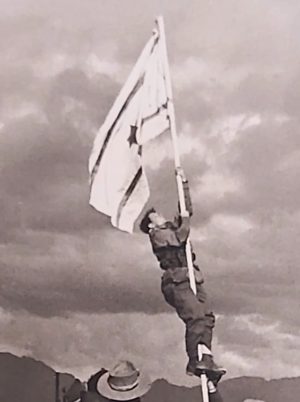
“Raising The Ink Flag” Original collection of Photographs Taken During the Conquest of the City of Eilat as Oart of Israel’s Independence War 1949
$11,000.00 Buy Now -
 Professional Collections, Historical Events Photos, Vintage Israeli Photographs, Professional collections
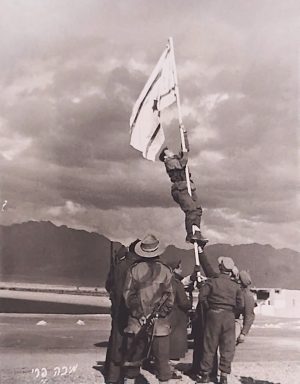
“Raising The Ink Flag” Original Iconic Photograph Taken During the Conquest of the City of Eilat as Oart of Israel’s Independence War 1949
$4,600.00 Buy Now
Sorry, the comment form is closed at this time.