

fbpx

“The Liberated Territories” — A Rare Letter by Menachem Begin from the Euphoric Months Following the Six-Day War

“The Liberated Territories” — A Rare Letter by Menachem Begin from the Euphoric Months Following the Six-Day War

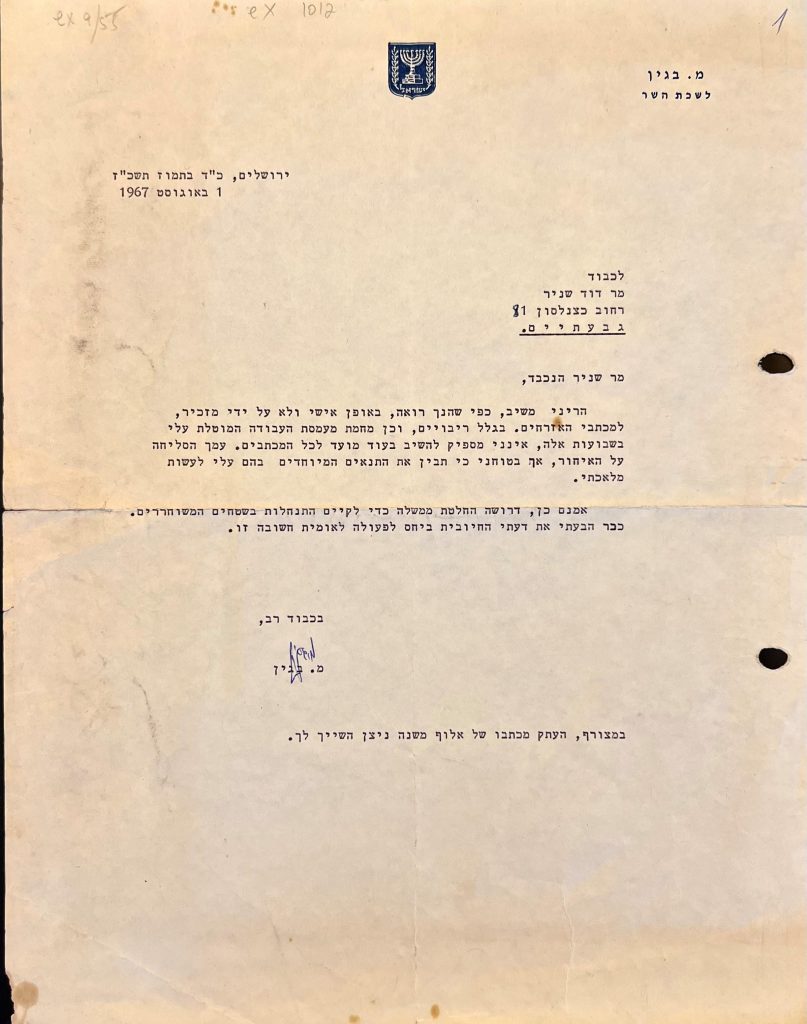
On August 1, 1967, less than two months after the end of the Six-Day War, an official letter was sent from the office of Menachem Begin to a citizen from Givatayim named David Shani.
The letter, bearing the heading “M. Begin — Minister’s Office,” was written during an extraordinary period in Israeli history — days of national euphoria, a sense of historic miracle, and a profound shift in Israeli consciousness following the dramatic victory in the war.

In the letter, Begin writes:

“Indeed, a government decision is required in order to establish settlements in the liberated territories.
I have already expressed my positive opinion regarding this important national undertaking.”

This wording — “the liberated territories” — carries deep historical and ideological significance. Begin does not use the term “occupied territories,” which would later become common in the international arena, but instead views the areas captured during the war as territories liberated and returned to the Jewish people after two thousand years of exile and struggle.

Israel After the Six-Day War

The Six-Day War in June 1967 completely transformed Israel’s situation. Within six days, Israel captured:

  • Judea and Samaria (the West Bank) and East Jerusalem from Jordan
  • The Gaza Strip and Sinai Peninsula from Egypt
  • The Golan Heights from Syria

Israeli society experienced enormous relief after the tense waiting period before the war, during which many feared an existential threat to the state. The swift victory was perceived almost as a historic miracle.

The reunification of Jerusalem and renewed access to the Western Wall stirred tremendous emotion throughout Israeli society and the Jewish world. At the same time, a political and ideological debate immediately began: what should be done with the newly captured territories?

Menachem Begin and His Role in the National Unity Government

At the time this letter was written, Menachem Begin was not yet Prime Minister. He was the leader of the Gahal alliance — the Herut-Liberals bloc — and had joined the national unity government formed by Levi Eshkol on the eve of the war.

Begin’s entry into the government was itself a historic event. For many years he had been the principal opposition leader and a controversial figure in the eyes of the Labor establishment. The Six-Day War created a sense of national emergency that united nearly the entire political system.

Begin was appointed Minister Without Portfolio, but his ideological influence was considerable — especially regarding the future of Judea and Samaria and Jerusalem.

The Beginning of the Settlement Movement

In the summer of 1967, there was still no clear governmental policy regarding settlement in the newly captured territories. In fact, the future of these areas remained entirely open.

The first settlements began shortly after the war:

  • Kfar Etzion was re-established in September 1967 after having fallen in 1948.
  • Additional communities later arose in the Jordan Valley, the Golan Heights, and the Hebron area.

The pioneers of settlement came from several different streams:

  • Members of the Labor movement who viewed the Jordan Valley as a vital security border.
  • Religious-Zionist groups who saw the return to Judea and Samaria as a historic and spiritual fulfillment.
  • Nationalist right-wing figures, led by Begin, who regarded the territories as an inseparable part of the historic Land of Israel.

In fact, historically speaking, the first settlements established after the Six-Day War were created during the rule of Israel’s Labor government — a government identified with the Israeli left of that era. Following the liberation of Judea and Samaria (“the West Bank”), the government permitted and in some cases even initiated the renewal of Jewish settlement in areas of historical and strategic significance, foremost among them the re-establishment of Kfar Etzion. Only in later years did the settlement enterprise become identified primarily with the nationalist right and ideological movements such as Gush Emunim.

Begin’s letter was written precisely during this transitional moment — when the idea of settlement was still in its infancy, before it evolved into a broad and institutionalized national policy.

Rare Menachem Begin Letter on the “Liberated Territories” — August 1967

“Liberated” Rather Than “Occupied”

One of the most important aspects of the letter is its language.

The term “liberated territories” was very common in Israel in 1967, especially among the nationalist right and large segments of the public. For many Israelis, Judea and Samaria were not perceived as foreign territory, but as ancient Jewish homelands — Hebron, Shiloh, Beit El, and the Old City of Jerusalem.

Begin was among the strongest advocates of this perception. In his view, this was not a conquest but a historic return to places identified with the origins of Jewish history.

Over the years, the question of how to define these territories became one of the most controversial issues in Israeli and international politics. Yet this letter captures a very early moment when the discourse was still framed by national euphoria and the fresh sense of historic destiny following the war.

A Small Document from a Decisive Era

Although this is a short and personal letter addressed to a private citizen, it reflects a dramatic period in Israeli history:

  • The first days after the Six-Day War
  • The beginning of the debate over the future of the territories
  • The early stages of the settlement movement
  • And the conceptual world in which the territories were viewed as “liberated” rather than “occupied”

It is a small historical document, yet one that captures a rare moment when Israel’s political future was still unwritten — and the debates that would shape the country for decades were only beginning to emerge.

PRIME MINISTER BEGIN AT HAIFA STATEMENT ON NO WITHDRAWAL FROM WEST BANK AND JERUSALEM

No Comments

Sorry, the comment form is closed at this time.