

 "Original Signature of David Ben-Gurion: Rare Historical Letter to Moshe Sharett on the Lavon Affair" 1961
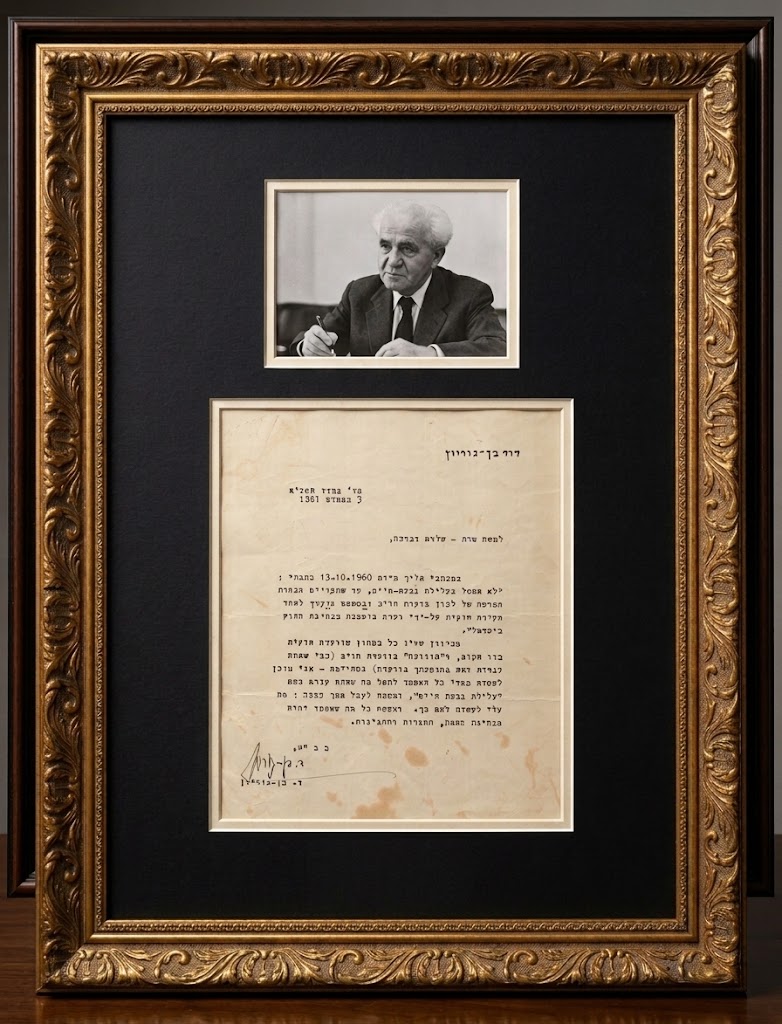
25 Oct The Scandal That Shook Israel – Rare Ben-Gurion Signed Letter to Sharett 1961
The Lavon Affair and History Repeating: Ben-Gurion’s Rare Letter Revealing That the Wars of the Generals and the October 7 Committees Have Happened Before
At the heart of the political and personal storm that tore apart the top echelon of the state’s leadership in the 1960s, a rare letter has been revealed, offering an extraordinary behind-the-scenes glimpse into the clash of titans between David Ben-Gurion and Moshe Sharett. This historical document from 1961 is not just another routine correspondence; it is a fascinating record in which the first Prime Minister attempts to settle deep personal scores, moments before the entire system collapses under the heavy weight of commissions of inquiry and mutual accusations.
The Lavon Affair, also known as the “Mishap” (Esek HaBish), is etched into the annals of the State of Israel as one of the most turbulent and severe security and political crises the nation has ever known. What began as a covert and failed sabotage operation by Israeli intelligence on Egyptian soil in 1954 quickly ignited an earthquake at the top of the government, leaving behind a trail of suspicions, lies, mutual accusations, and an unprecedented crisis of trust within the defense and political echelons that shattered the ruling party from within.
This history is repeating itself in troubling cycles. The emotional battle over the establishment of a state commission of inquiry for the October 7 failure, the evasion of responsibility, and the mutual finger-pointing between the political and military ranks—seem as if they were taken straight from that political storm. Just as the system today is torn over the question of responsibility for the disaster and the composition of the inquiry committee, so did the earth shake in Israel over 60 years ago. Then, as now, the Minister of Defense and the Head of Military Intelligence pointed an accusing finger at one another, while the Prime Minister refused to recognize political inquiry committees and demanded a strictly legal and objective investigation.
Letter Content The letter was written by David Ben-Gurion to Moshe Sharett on the 15th of Adar, 5721 (March 3, 1961), and this is its full content:
“In my letter to you dated October 13, 1960, I wrote: ‘I will not deal with the Givat Haim libel until the clarification of the Lavon affair is concluded in the Foreign Affairs and Defense Committee and in the trial that will be held following a legal investigation by a competent committee according to the law in Israel.’ Since there is no certainty that such a legal committee will be established, and ‘The Horror’ in the Foreign Affairs and Defense Committee (as you defined it in your appearance before the committee) has ended – I am willing to do everything possible on my part to eliminate what you call the ‘Givat Haim libel,’ and I would be glad to receive a proposal from you: what I must do to achieve this. And I will do everything possible in terms of truth, friendship, and fairness”.
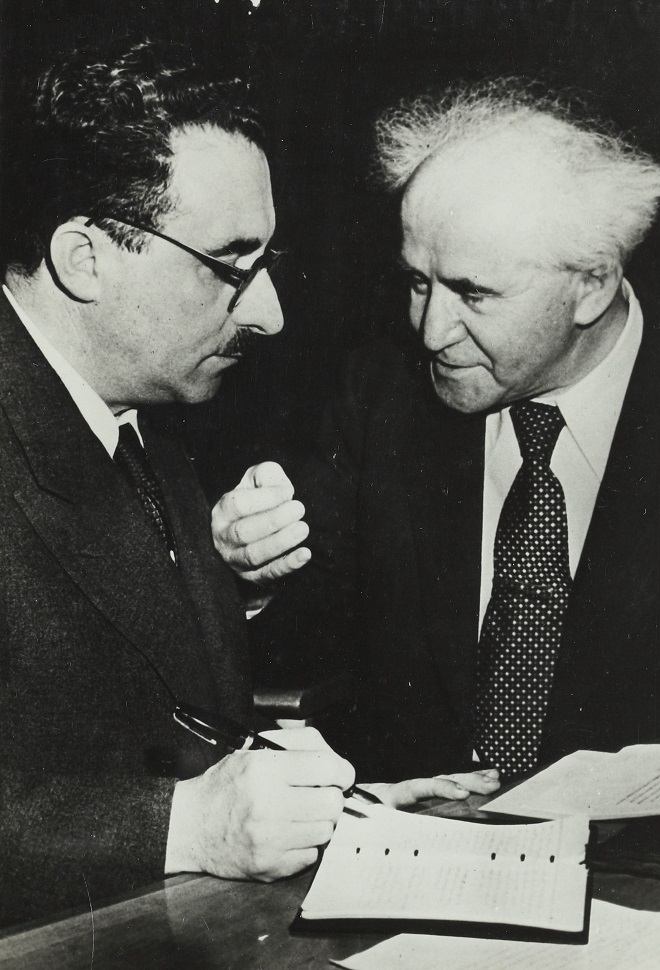
The Lavon Affair
The crisis known as the “Mishap” began in July 1954, surrounding a covert Israeli intelligence operation named “Operation Susannah.” At the time, Britain and Egypt were negotiating the evacuation of the British army from the Suez Canal zone—a move Israel viewed as a severe security threat. To thwart the agreement, a covert cell of Egyptian Jews (Unit 131 of Military Intelligence) was activated and instructed to plant bombs and incendiary devices in Western (British and American) public buildings, cinemas, post offices, and cultural institutions in Cairo and Alexandria. The goal was to create a false impression of governmental instability in Egypt, prove that the Egyptian regime was incapable of protecting foreigners, and cause the British to cancel their withdrawal.
The plan collapsed on July 23, 1954, when an explosive device prematurely ignited in the pocket of one of the cell members at the entrance to a cinema in Alexandria. The network members were exposed, captured by the Egyptian authorities, interrogated under torture, and subjected to a show trial. Two of them, Dr. Moshe Marzouk and Shmuel Azar, were executed by hanging. Others were sentenced to long prison terms, and Israeli intelligence officer Meir Max Bineth committed suicide in his cell.
The resounding failure sparked an earthquake in Israel and immediately raised the fateful and famous question: “Who gave the order?”. The then-Minister of Defense, Pinhas Lavon, denied all responsibility, claiming that the Head of Military Intelligence, Colonel Binyamin Gibli, had acted on his own accord and even forged documents to incriminate him. Conversely, Gibli strongly asserted that Lavon had given him the order verbally. The crisis tore apart the leadership of the Mapai party and led to the establishment of a series of inquiry committees throughout the 1950s and 1960s. In 1960, the “Committee of Seven” (a governmental ministerial committee) cleared Lavon of responsibility, but David Ben-Gurion, viewing this as a miscarriage of justice, adamantly refused to accept its conclusions. He demanded an objective, legal commission of inquiry composed of judges rather than a political committee, as clearly reflected in his demand for a “competent committee according to the law” in his letter to Sharett. Ben-Gurion’s uncompromising insistence ultimately led to his resignation from the premiership and the historic split within Mapai.
Givat Haim Libel The term refers to a profound crisis that erupted following a speech delivered by Ben-Gurion at a Mapai conference at Kibbutz Givat Haim in January 1957. In this speech, Ben-Gurion leveled harsh and public criticism at Moshe Sharett’s conduct as Foreign Minister. Sharett, who had been ousted from his position by Ben-Gurion just months earlier (in June 1956), viewed these remarks as intentional defamation, historical distortion, and an attack on his life’s work, defining them as a “blood libel.” In the 1961 letter, Ben-Gurion expresses a willingness to do everything possible to “eliminate what you call the ‘Givat Haim libel'” for the sake of friendship and fairness.
Complex Relationship
Ben-Gurion and Sharett worked together for decades in the leadership of the Yishuv and the State, but they represented opposing worldviews. Ben-Gurion advocated for security activism and forceful resolutions, while Sharett led a moderate and diplomatic approach that sought to consider global public opinion. Their disagreements reached a peak when Sharett was forced to resign in 1956, leaving a deep personal rift that remained unhealed until Sharett’s death.
David Ben-Gurion
The first Prime Minister and Minister of Defense of the State of Israel. The leader of the Zionist movement who declared the establishment of the State, led it during the War of Independence, founded the IDF, and shaped the state’s institutions.
Moshe Sharett
The second Prime Minister of Israel (1954-1955) and its first Foreign Minister (1948-1956). One of the architects of Israeli diplomacy, he managed the diplomatic struggle for the state’s establishment at the UN and worked to strengthen Israel’s international ties through a vision of dialogue and moderation.
Sorry, the comment form is closed at this time.