

15 Feb While the World Was Burning: Bauhaus Modernist Zionist Art in Mandate Palestine Ertz Israel 1940s
From Pioneer to Protector — Rare Bauhaus Zionist Posters from Mandate-Era Tel Aviv
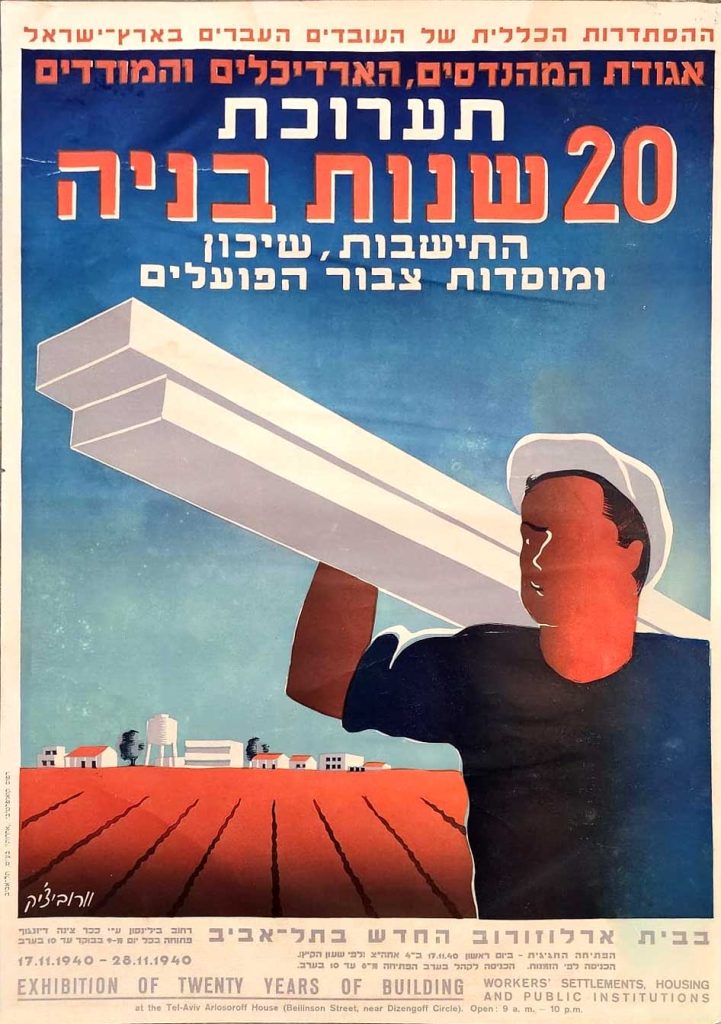
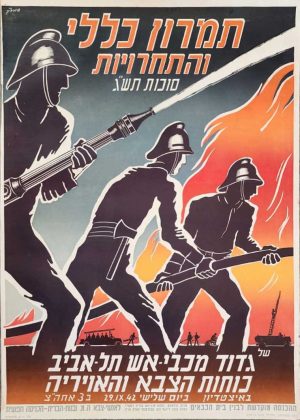
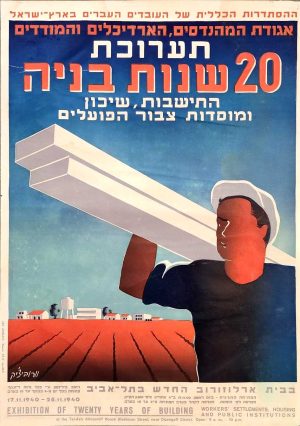
These two posters — designed by the Bauhaus-trained artist Moshe Raviv-Vorovchik (Moi Ver) — reveal not only striking modernist design but the story of an entire culture in formation. They are not merely announcements of municipal events; they are visual expressions of the Zionist idea during the British Mandate, when a new society was being built in the Land of Israel amid uncertainty and world war.
Raviv-Vorovchik was born in Eastern Europe, educated in the Jewish avant-garde atmosphere of Vilna, and later studied at the Bauhaus in Dessau under Paul Klee and Kandinsky. There he absorbed the concept that art is not decoration but a tool for shaping society. After a period in Paris, where he created innovative photographic and photomontage works, he immigrated to Eretz Israel in the early 1930s and brought with him the most advanced European visual language of the time. In the country he worked as a painter, photographer and graphic designer, accompanying public institutions, exhibitions and social organizations, becoming an integral part of the emerging culture of the Yishuv. His immigration saved him from the fate of many European artists who perished in the Holocaust, and thus his local work represents cultural continuity reborn here. His works were later exhibited at the Tel Aviv Museum of Art and at the Centre Pompidou in Paris, recognition that the modernism created in the country formed part of global modernism.
Tel Aviv of those years functioned as a living laboratory of the Bauhaus. Architects and artists arriving from Germany and Central Europe created a city with a unified language: clean lines, horizontal balconies, functionality and light. The White City was not merely an architectural style but a worldview — a modern, collective and organized society. Raviv-Vorovchik’s graphics integrate naturally into this environment; the same flat surfaces, geometric figures and dynamic movement appear both in buildings and in posters.
The first poster presents the pioneer carrying a beam — the person physically building the land. This is the myth of Hebrew labor: settlement, housing and public institutions as a social vision. The figure is not an individual but a new human type — the builder of the nation.
The second poster continues the story of a society already built and beginning to protect itself. In the Tel Aviv fire brigade drill, three firefighters move as one unit toward the flames. They are not romantic heroes but part of an organized mechanism — a modern city with emergency services, civic discipline and public responsibility. During World War II, when there was real fear of bombing and invasion, civil-defense drills were part of national preparation for a future state. If the pioneer builds — the firefighter protects; together they form a functioning society.
All this occurred while Jewish culture in Europe was being destroyed. In the Land of Israel, under British rule and in difficult conditions of scarcity and threat, neighborhoods, institutions and civic services continued to be built. These posters therefore are not only graphic art but historical testimony: the transition from a group of pioneers to an organized modern society. Tel Aviv was not only a city but a modernist statement, and Raviv-Vorovchik was one of the artists who shaped its visual identity — on walls and on paper alike. Both posters were exhibited in exhibitions at the Tel Aviv Museum of Art and at the Centre Pompidou in Paris.
Sorry, the comment form is closed at this time.