

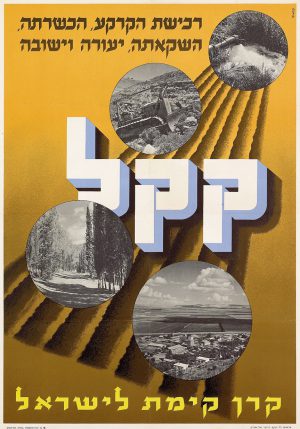
 Vintage JNF Poster Jewish National Fund Israel 1958 Franz Kraus
19 Apr The First Call: Jewish Recruitment Posters and the Birth of the Jewish Brigade
The Call to Victory: The First Recruitment Posters for Jews in Palestine and the Story of the Jewish Brigade in the Shadow of World War II

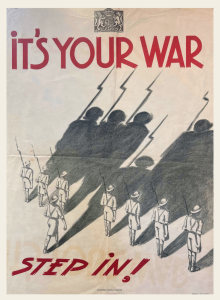
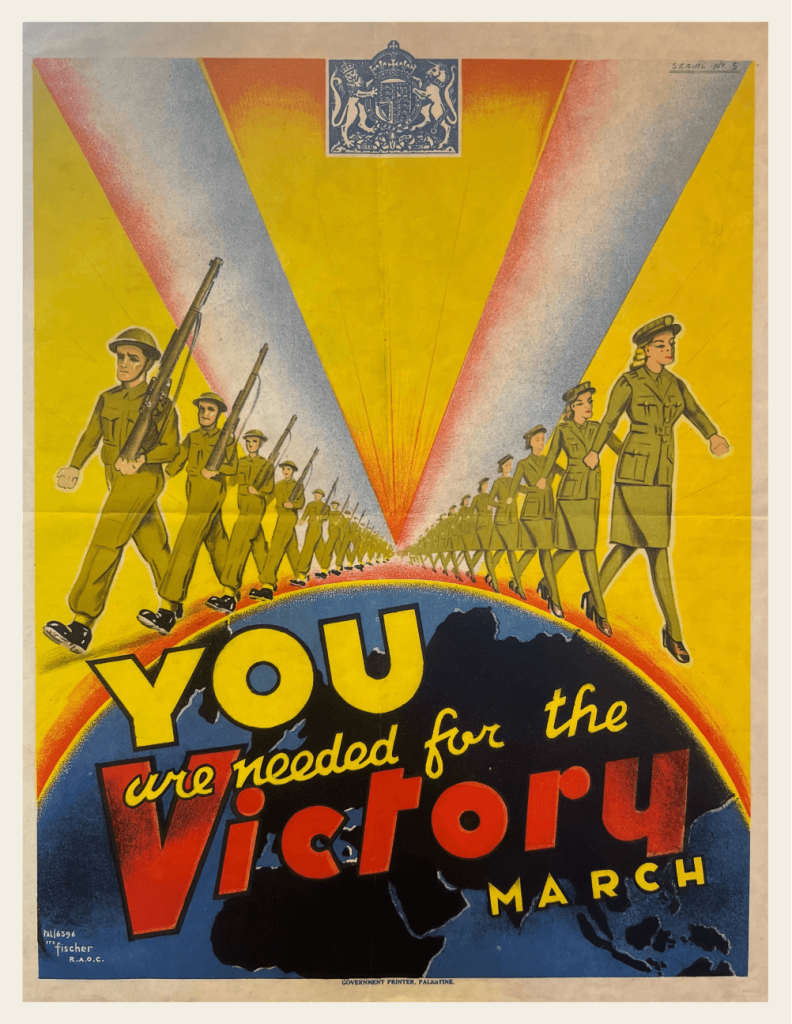
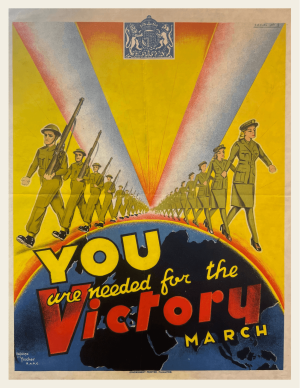
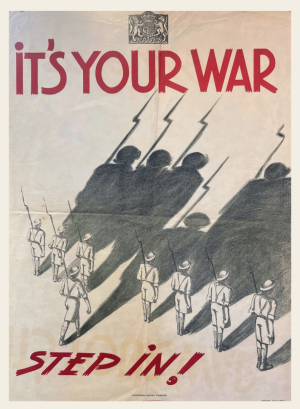
The two posters before us are considered the first recruitment posters printed by the British Mandate government in Palestine to enlist Jewish volunteers, and they are exceptionally rare items that scarcely appear in any public archive or documented collection, representing an extraordinary and early testimony to the initial stage of official propaganda before a defined Jewish fighting framework had even taken shape; according to the accepted attribution, they were printed as early as 1933, a period in which the idea of a Jewish military force within the British system was still only an aspiration rather than a reality; already at first glance it is evident that all the text on the posters is in English alone – “YOU are needed for the Victory March” and “IT’S YOUR WAR – STEP IN!” – reflecting a stage in which there was not yet awareness or policy to incorporate Hebrew into official propaganda,
and the appeal was made entirely within the framework of the British Empire and its language, while at the bottom appears the official marking “Printed in Palestine” and in some versions “Government Printer, Palestine,” a bureaucratic stamp that situates these works firmly within the colonial administrative system, and at the top stands the emblem of the British Crown – the royal crest with its lions – a clear symbol of imperial authority operating in the Land of Israel; the first poster, rich in color and optimistic in tone, presents rows of Jewish men and women marching from both sides toward a bright vanishing point, with red, white, and blue rays converging to create a sense of destiny and imminent victory, and the globe at the bottom situates the struggle within a global context, while the inclusion of women emphasizes a broad national mobilization rather than a purely military one; in contrast, the second poster adopts a far more dramatic and somber visual language, with small figures casting large shadows of soldiers armed with bayonets, a clear metaphor that each individual can become a powerful fighting force, and the direct slogan “It’s YOUR War – Step In!” removes any distance between the viewer and the conflict, imposing an immediate personal responsibility; together, the two posters are not merely recruitment tools but a reflection of a deeper transformation – from hopeful persuasion to urgent call to action in the face of an escalating reality;
within this context, one must understand the development of the Jewish Brigade, which emerged only after a prolonged political struggle led by the leadership of the Jewish Yishuv, demanding recognition of a distinct Jewish fighting unit, a demand repeatedly rejected by the British who feared strengthening Jewish national aspirations, until finally in 1944, under mounting pressure and growing wartime needs, the Jewish Brigade Group was established, consisting of approximately 5,000 soldiers from Palestine, bearing a blue-and-white flag with the Star of David and fighting against German forces on the Italian front as part of the British Eighth Army; the importance of the Brigade extended far beyond its military operations, as it created for the first time an officially recognized Jewish fighting framework, provided critical combat experience and leadership training that would later form the backbone of the Israel Defense Forces, and strengthened Jewish national consciousness within an international military structure; after the war, Brigade soldiers played a crucial role in assisting Holocaust survivors across Europe, organizing escape networks known as the Bricha, facilitating immigration to Palestine, and in some cases participating in acts of retribution against Nazi perpetrators, thus serving as a bridge between the destruction of European Jewry and the emergence of a Jewish state; yet the recruitment into the Brigade and the British Army took place within a deeply complex reality in Mandatory Palestine, where British rule was increasingly perceived by many Jews as restrictive and even hostile, particularly after the 1939 White Paper which severely limited Jewish immigration and land acquisition at the very moment European Jewry faced annihilation, creating a profound sense of betrayal;
at the same time, Jewish underground organizations such as the Haganah, Irgun, and Lehi operated within the country, some choosing cooperation with the British in the fight against Nazi Germany, while others continued or intensified their struggle against British rule, producing a deep internal dilemma within the Yishuv – whether to enlist in the British Army and contribute to the global war effort, or to resist the very authority that obstructed Jewish national aspirations; the leadership articulated the complex position of fighting Germany while continuing the political struggle against British policy, yet in practice this tension ran through families, movements, and institutions alike; all of this unfolded against the backdrop of World War II, the most extensive and devastating global conflict in history, in which Nazi Germany and its allies conquered vast territories across Europe and North Africa, while Britain, the Soviet Union, and the United States waged total war across land, sea, and air, a war marked by massive aerial bombardments, large-scale armored battles, and the systematic extermination of European Jewry in the Holocaust; for the Jewish community in Palestine, the war was not a distant event but an immediate and tangible threat, as German forces advanced through North Africa to El Alamein, raising real fears of invasion, while the British prepared defensive and contingency plans, and the Yishuv itself braced for the possibility of direct confrontation; simultaneously, information about the fate of European Jews gradually accumulated, evolving from rumor into a growing understanding of the scale of destruction, intensifying the sense of urgency and moral obligation to act; within this entire charged reality – between temporary alignment with an empire and a parallel struggle for independence, between global war and local existential threat – these extraordinarily rare posters stand as powerful visual documents, not merely as recruitment tools but as testimonies to a historic moment in which propaganda, politics, national identity, and world war converged, calling upon the individual to step forward and become an active participant in shaping the destiny of his people and of history itself.
Sorry, the comment form is closed at this time.