

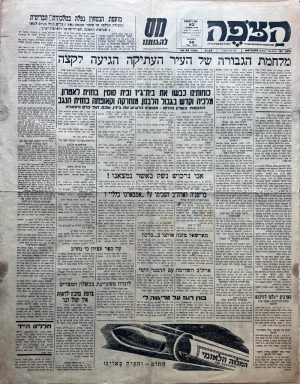
 Rare Israeli Newspaper Independence War 'The Fightings in Jerusalem are over' May 1948
Shop

Time Magazine Six Day War “How Israel Won The War” June 16 1967
$500.00
SOLD
| Artist / Creator | |
|---|---|
| Year | |
| Condition | |
| Technique | |
| A |
Description
Full Time Magazine Six Day War “How Israel Won The War” June 16 1967
On The Front page General Mosh Dayan
The Six-Day War (Hebrew: מלחמת ששת הימים, Milhemet Sheshet Ha Yamim; Arabic: النكسة, an-Naksah, “The Setback” or حرب ۱۹٦۷, Ḥarb 1967, “War of 1967”), also known as the June War, 1967 Arab–Israeli War, or Third Arab–Israeli War, was fought between June 5 and 10, 1967 by Israel and the neighboring states of Egypt (known at the time as the United Arab Republic), Jordan, and Syria. Relations between Israel and its neighbours had never fully normalised following the 1948 Arab–Israeli War. In the period leading up to June 1967, tensions became dangerously heightened. In reaction to the mobilisation of Egyptian forces along the Israeli border in the Sinai Peninsula, Israel launched a series of preemptive airstrikes against Egyptian airfields. The Egyptians were caught by surprise, and nearly the entire Egyptian air force was destroyed with few Israeli losses, giving the Israelis air superiority. Simultaneously, the Israelis launched a ground offensive into the Gaza Strip and the Sinai, which again caught the Egyptians by surprise. After some initial resistance, Egyptian leader Gamal Abdel Nasser ordered the evacuation of the Sinai. Israeli forces rushed westward in pursuit of the Egyptians, inflicted heavy losses, and conquered the Sinai. Nasser induced Syria and Jordan to begin attacks on Israel by using the initially confused situation to claim that Egypt had defeated the Israeli air strike. Israeli counterattacks resulted in the seizure of East Jerusalem as well as the West Bank from the Jordanians, while Israel’s retaliation against Syria resulted in its occupation of the Golan Heights. On June 11, a ceasefire was signed. Arab casualties were far heavier than those of Israel: fewer than a thousand Israelis had been killed compared to over 20,000 from the Arab forces. Israel’s military success was attributed to the element of surprise, an innovative and well-executed battle plan, and the poor quality and leadership of the Arab forces. Israel seized control of the Gaza Strip and the Sinai Peninsula from Egypt, the West Bank and East Jerusalem from Jordan, and the Golan Heights from Syria. Israeli morale and international prestige was greatly increased by the outcome of the war and the area under Israeli control tripled. However, the speed and ease of Israel’s victory would lead to a dangerous overconfidence within the ranks of the IDF, contributing to initial Arab successes in the subsequent 1973 Yom Kippur War. The displacement of civilian populations resulting from the war would have long-term consequences, as 300,000 Palestinians fled the West Bank and about 100,000 Syrians left the Golan to become refugees. Across the Arab world, Jewish minority communities were expelled, with refugees going to Israel or Europe. WIKI
Framed
All our products are 100% original
World Wide Free Shipping
The Farkash Gallery packs each item professionally. We work with the leading postal companies - UPS, FeDex etc. When
shipping internationally, the buyer is responsible for any customs, duties, or taxes that are set by your destination
country.
Delivery
Estimated Delivery Time is 7-14 days.
Payments
PayPal - Visa, Mastercard, American Express, Discover
Returns
Returns accepted if product not as described. Buyer pays return shipping fee.
100% Money back guarantee (Not including shipping costs)
Guarantee
Money Back Guarantee. Get the item you ordered or get your money back. Buy with confidence.
Related Products
-
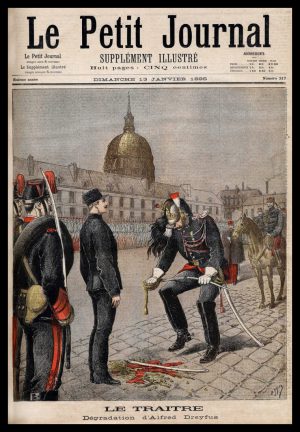
“Alfred Dreyfus Degradation Ceremony”Original Le Petit Journal, Printed in paris france January 13, 1895
$1,400.00 Buy Now -
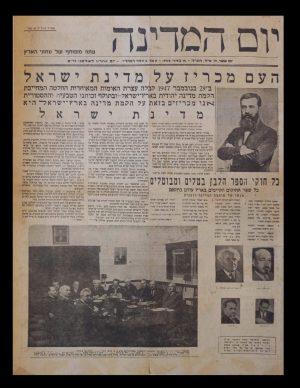
“The Day of The State” RARE, Decleration of Israel’s Independence Original Official Newspaper, Israel 1948
$4,500.00 Buy Now -
“Davar Hashavua” Rare Weekly Newspaper During The War of Independence 24.6.1948
-
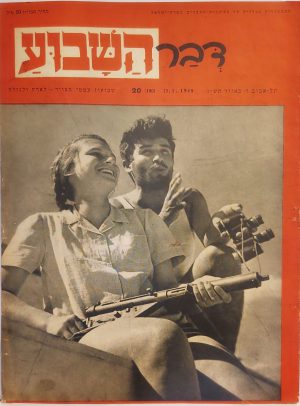
“Davar Hashavua” Rare Weekly Newspaper During The War of Independence 13.4.1948
$250.00 Buy Now
